Tiger Woods peaked a little younger than 35. Since 2009, when his personal life fell apart, he has ceased to dominate the game. He has not won a major tournament since 2008. He won no PGA tournaments at all in 2010, 2011 or 2014. Small wonder he has announced that he is taking an indefinitely long break from the sport. The question is, can he recover? http://econ.st/1FWt673
WHEN Tiger Woods burst onto the global stage in 1997, The Economist was ecstatic:NOT since Kim Jong Il’s five holes-in-one on his first day on the links, which may...
ECON.ST
At 68, Pele Awaits His Payday
Pele, perhaps the greatest player ever in the world's most popular sport, is still trying to scratch out a living at the age of 68.
He's just signed a merchandising deal with Nomis, a little-known Swiss cleat manufacturer, in a move that could become a runaway success -- or yet another example in a lengthy list of business deals whose history is as spotty as his goals were sublime.
On the soccer field, Pele's legacy is virtually unrivaled in the modern history of international sports. A member of three World Cup champions, he scored nearly 1,300 goals in a career that spanned three decades and two continents. But during the 32 years since his retirement, Pele, once one of the most recognizable athletes in the world, has failed to leverage his fame into the vast fortune that other sports superstars like Michael Jordan enjoy today.
In some ways Pele himself is accountable for not capitalizing on his superstar status. Despite several overtures, he has never served as coach or a top team executive, or as a major television commentator in the spirit of ex-NFL great John Madden or golf's Johnny Miller.
But Pele's circumstances can also be blamed on the year of his birth, since his career ended just before the emergence of the modern sports-marketing behemoths that, over time, have spawned a race between basketball's LeBron James and golf's Tiger Woods to become the first billionaire athlete. David Beckham, currently the world's top-earning soccer player, collected about $45 million last year in salary and endorsements. Pele's big payday, by contrast, came in 1975, when the New York Cosmos signed him for $4.5 million -- the top salary for a professional-team athlete in the U.S. at the time but about a third as much as the Kansas City Royals pay mediocre outfielder Jose Guillen.
Pele's attempts to score in the business world have at times fallen short. He owned a construction company that went bust and a sports-marketing firm that collapsed amid a financial scandal. His product endorsements included a successful relationship with MasterCard but also a line of retro sportswear from Puma in 2005 that failed to take off. And when he became a pitchman for erectile-dysfunction drug Viagra, Pele stated he did not personally need the drug but would use it if he did.
The soccer great says he's not bitter about his timing or his business choices, even if it has left him still hustling at an age when current superstars may have little else to do but count their money.
'Their careers are short, so they need to make a lot of money,' he said, lamenting that the promise of money motivates the world's top players today rather than the love of the game that drove him. 'A kid who plays for money moves all around and is not concerned with his sport or the team.'
Now comes the Nomis deal -- the latest effort by Pele to transform himself into a branded empire rather than simply to associate him with established companies and products. There are a half-dozen Pele-brand coffee shops in Brazil, a potential bio-pic, and plans for a video game and an animation feature in India. All of this raises the question of whether a near-septuagenarian still has enough marketing juice to compete with superstars one-third his age in a youth-dominated industry. In short: Will a 9-year-old in Spain want to buy Pele's cleats or Lionel Messi's?
Pele has no doubt he can still hold his own. 'My career gives my brand positive values and attributes and a message that goes from generation to generation,' Pele said through a translator last week. 'It's not like athletes now that are at the top of the game and then start playing badly. In my career, I have done it all. My message is clear from generation to generation. Pele is a guarantee.'
If the cleats and the other potential licensing ventures become a hit, Pele could finally have the chance to carve out the sort of fortune he never has attained. Born Edison Arantes do Nascimento, Pele first became a worldwide star in 1958 as a 17-year-old sensation for Brazil in the World Cup, where he danced through defenders to score six goals, including a semifinal hat trick. In retirement, though, Pele has worked largely as worldwide ambassador for soccer.
Three years ago, Paulo Ferreira, chief executive of Rio de Janeiro-based Prime Licensing, the company originally charged with creating the Pele brand, predicted Pele would quickly become a $100-million a year business. That hasn't happened. Mr. Ferreira contends Pele's new partnership with IMG Worldwide will finally help him reach his full marketing potential. 'Pele is very strong for consumer goods, entertainment and also real-estate venues,' Mr. Ferreira said.
Simon Skirrow, Nomis' founder, said that with Pele, the company saw a chance to build its product around someone they believe represents the performance-first qualities they embrace. (Sources say Pele will receive a royalty on sales rather than a flat licensing fee.) Mr. Skirrow added that he never thought Pele would be available to work closely with them to design and market a cleat. But, as he noted, 'He doesn't have a huge amount of projects on his plate right now.'
IMG is trying to change that. Bruno Maglione, an executive vice president for IMG, said Pele's potential for marketing remains high despite his age.
But image isn't everything. 'He is a living legend, but that only gets you in the door with consumers,' said Ryan Schinman of New York-based Platinum Rye Entertainment, which advises companies on celebrity marketing. 'You have to back it up with a superior product.'
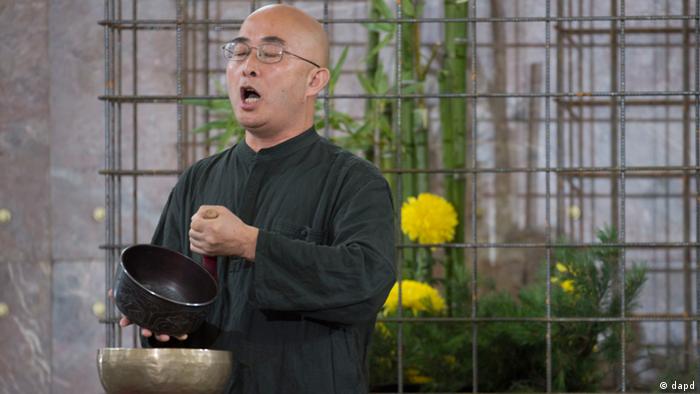
Der chinesische Dissident Liao Yiwu am 17.08.2011 im Haus der Berliner Festspiele während er sein Gedicht “Massacre” vorträgt, das natürlich vom “Massaker auf dem Tian’anmen-Platz” 1989 handelt. Das Erscheinen seines neuesten Buchs “Für ein Lied und hundert Lieder” (S. Fischer) bezahlte er mit dem Bleiberecht in seiner Heimat. Das Buch handelt von seiner vierjährigen Zeit als Gefangener. Seit Anfang Juli lebt Yiwu im Berliner Exil. Foto: Barbara Klemm
Poet’s Nightmare in Chinese Prison
By ELAINE SCIOLINOApril 18, 2013
BRUSSELS — Liao Yiwu was a reluctant dissident.
A Chinese poet and storyteller nourished on Beat generation
literature, he picked fights, drank to excess and despised politics.
“我對群眾運動或者外國輸入的民主、自由、人權和愛之類東西根本不感興趣,”他在1989年北京主張民主的學生運動上這樣宣布,“如果破壞是不可避免的,那就讓它來吧。”
之後是天安門廣場上的鎮壓。廖亦武的看法轉變了,他寫了一首充滿憤怒與挫敗感的長詩《大屠殺》,並將其朗誦錄音。他還和朋友們一起拍了一部名叫《安魂》的電影——安撫那些死者的靈魂。
1990年,他以反革命罪名被逮捕,在各種監獄中忍受了4年毆打、刑訊、飢餓與羞辱。第16次要求出國被拒絕後,他再度因為自己的寫作面臨入獄的威脅,2011年,他逃入越南邊境,之後前往柏林,現在仍然生活在那裡。
如今廖亦武的獄中生活回憶錄《證詞》(英譯《一首歌和一百首歌:詩人的中國監獄之旅》[For a Song and a Hundred
Songs: A Poet’s Journey Through a Chinese
Prison])在西方可以讀到了。這本中國的禁書在德國成了暢銷書,並獲得大獎;法語版也獲得了評論界的稱讚;還被翻譯成捷克語、意大利語、波蘭語、葡
萄牙語、西班牙語和瑞典語。英文版將於6月由New Harvest出版社出版。6月13日,廖亦武將赴紐約參加發行儀式,並在紐約公共圖書館做一次演講。
“我相信歷史,相信寫下來的歷史,這樣它就不會消失或是生我們的氣,”3月底他在這裡參加了一次文學節,在接受採訪時這樣說道,“我曾經多次夢見那些已經逝去的人們,但他們的靈魂仍然與我們同在。”
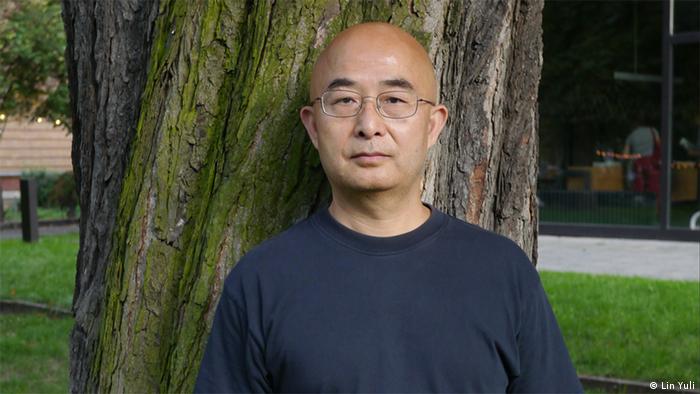
54歲的廖亦武穿着素凈的黑色褲子、黑色T恤和帶風帽的夾克衫,頭髮推成光頭,皮膚白凈平整,但他內心卻有很多傷痕。
“我的生活現在比以前好多了,”他通過一個翻譯,用中文回答問題,“但是天安門屠殺是我生命中的一部分。我永遠不可能逃避它。”
廖亦武從1990年開始在家人偷送進監獄的信封背面和廢紙上撰寫回憶錄。他被釋放時想辦法把手稿也帶了出去,但書稿兩次遭到沒收,兩次他都必須憑記憶重新寫出來。
英文書名來自獄中發生的一件事,當時他違背獄規唱起歌來;作為懲罰,他被勒令唱100首歌。他嗓子啞了,獄警就用電棍插入他的肛門電擊他。
“我感覺就像一隻被拔毛的鴨子,”他寫道。
在這本書里,他描述了囚犯們森嚴的自創等級制度。頂層是一個頭領,手下有打手、管家和內閣成員;底層則是幾群“奴隸”,包括“熱水賊”,負責為上層
打開水和按摩;“洗衣賊”,負責洗衣服和清理被褥里的虱子;還有年輕英俊的“娛樂賊”,負責為領袖表演歌舞小品,並提供性服務。作為政治犯,廖先生幸運地
進入了“中層階級”,享有一定特權——比如可以把三餐帶回囚室自己用餐——這讓他可以免受下層階級遭受的一些虐待。
早先,那個頭領給了他一份長長的“菜單”,上面都是各種折磨方式,如果他違背命令,可以選擇以什麼樣的方式受罰。其中有“川味煙熏鴨”(打手去燒犯人的陰毛和龜頭),“清湯掛麵”(犯人吃一碗廁紙和小便做的湯)和“裸體雕塑”(犯人裸體站立,擺出各種頭領要求的姿勢)。
關於牢獄生活,廖先生最恐怖的記憶並不是酷刑和被剝奪自由,甚至也不是看着同獄犯人被帶出去執行死刑;而是一次失敗的自殺。他被銬着,用繩索捆綁接受電擊,於是決定自殺,向前沖以頭撞牆。
“所有犯人都指責我假裝自殺,是個好演員,”他在採訪中說,“沒有人相信我真想死。我很憤怒——非常非常憤怒。沒有人在乎。”
廖亦武漸漸學會了一些生存技能。一個同獄犯人教會他用頭倒立,作為鍛煉和放鬆的方式。另一個同獄犯人是個80多歲的和尚,他教會廖先生吹簫,那是一種古老的,笛子式的樂器。還有一個犯人會用竹子和木頭的碎片自製鋼筆。還有一個犯人讀聖經,他照顧廖亦武,給了他智慧。
直到現在,他還經常做噩夢。“我在天上飛,看見地面上的人帶着槍和刀子追我,”他說,“但我不是一隻沒有腳的鳥,等我飛不動了,就落到地上。那些人越來越近,他們就要來攻擊我了,這時我就會滿心恐懼地醒來。”
廖亦武覺得2012年諾貝爾文學獎頒發給莫言是一種嘲弄。“想像你的國家發生了一場共產黨帶來的大屠殺,然後有人給這個國家的御用詩人頒了一個獎,”他說,“你見過這麼驚人的事情嗎?”
他覺得自己的任務就是講述人類苦難的故事,而不是做個改革者,努力去改變中國,這個被他稱為“骯髒的豬圈”的地方。“我對中國會變成什麼樣不感興趣,”他說,“我的建議就是中國應當分裂成幾十個小國,這樣就不會像現在這樣成為可怕的威脅。”
如今,廖亦武在西方以一本《中國底層訪談錄》(英譯為《行屍走肉》[The Corpse Walker])享有國際性聲譽。《證詞》去年秋天獲得了德國的書業和平獎。近期他去巴黎期間接受了30次記者採訪,並在東京宮表演了唱歌和西藏頌缽。
此外他還在創作新書,是關於自己大家族的歷史。他現在在柏林舒適的西區擁有一棟小小的花園公寓,屋裡有一張床、一張桌子、一個烹飪的鍋和茶壺。夜晚他就在那裡帶着長久的激情寫作。
他承認三個月來他一直在上德語課,但還是放棄了,現在他的空餘時間大部分是與中國流亡者們交往。
他通過Skype和中國的其他親友保持聯繫。他和中國的妻子已經離婚,同自己的女兒相處的時間只有不到兩個月,她現在已經20多歲了。
“這是我生活中最悲哀的部分,”他說,“我能怎麼辦?我們的感情已經徹底破裂了。”
他停頓了一下,問,“你覺得我孤獨嗎?”
本文最初發表於2013年4月10日。
“I have never taken an interest in mass movements or foreign imports
such as democracy, freedom, human rights and love,” he declared as the
student pro-democracy movement unfolded in Beijing in 1989. “If
destruction is inevitable, let it be.”
Then came the Tiananmen crackdown. Mr. Liao was
transformed. He composed and recorded a poem of fury and frustration
called “Massacre.” He joined with friends to make a film called
“Requiem” — to appease the souls of the dead.
He was arrested in 1990 as a counterrevolutionary and endured four
years of beatings, torture, hunger and humiliations in a series of
prisons. After being denied an exit permit 16 times and facing new
threats of imprisonment for his writing, he slipped across the border
into Vietnam in 2011 and made his way to Berlin, where he still lives.
Now Mr. Liao’s prison memoir, “For a Song and a Hundred Songs: A
Poet’s Journey Through a Chinese Prison,” has appeared in the West.
Banned in China, it has been a best seller and prizewinner in Germany;
has won critical acclaim in a French-language edition; and is being
translated into Czech, Italian, Polish, Portuguese, Spanish and Swedish.
An English-language version will be published by New Harvest in June. Mr. Liao will be in New York for the publication and is to give a lecture at the New York Public Library on June 13.
“I believe in history, in writing down history, so it doesn’t
disappear or get angry with us,” he said in late March in an interview
here, where he was participating in a literary festival. “I have had
many dreams about people who have been dead a long time, but their souls
are still among us.”
Dressed in sober black pants, a black shirt and an anorak, his head
shaved, his skin unlined and unblemished, Mr. Liao, 54, wears his scars
inside.
“My life is better now than it has ever been,” he said in Chinese
through an interpreter. “But the Tiananmen massacre is part of my life. I
can never escape it.”
Mr. Liao (pronounced lee-YOW) began his memoir in 1990 on the backs
of envelopes and scraps of paper his family smuggled into prison. He
managed to sneak out his manuscript when he was released. But twice it
was confiscated, and he had to reconstruct it from memory both times.
The title refers to an incident in prison when he broke the rules by
singing; as punishment, he was ordered to sing 100 songs. When his voice
gave out, he was tortured with electric shocks from a baton inserted
into his anus.
“I felt like a duck whose feathers were being stripped,” he writes.
In the book he describes the rigid hierarchy the prisoners created
for themselves. At the top was a chief with enforcers, a housekeeper and
cabinet members; at the bottom were several groups of “slaves,”
including “hot water thieves” who brought the upper classes hot water
and gave massages; “laundry thieves,” who washed clothes and crushed
fleas in the bedding; and young, handsome “entertainment thieves” who
sang, danced and performed skits and sex acts with the leaders. As a
political prisoner, Mr. Liao was fortunate to be placed in the “middle
class,” a status that came with certain privileges — he could bring his
meals back to the cell and eat at his own pace, for example — and that
spared him some of the abuse suffered by the underclasses.
Early on the chief gave him a long menu of “dishes” of torture, to
choose what to be served if he disobeyed an order. Among them were
“Sichuan-style smoked duck” (the enforcer burns the inmate’s pubic hair
and penis tip); “noodles in a clear broth” (the inmate eats a soup of
toilet paper and urine); and “naked sculpture” (the inmate stands naked
and strikes different poses ordered by the chief).
Mr. Liao’s most terrible prison memory was not of torture,
deprivation or even watching fellow inmates sent for execution. It was
of a failed suicide attempt. Handcuffed, bound with ropes and subjected
to electric shocks, he decided to kill himself. He hurled his body
forward, hitting his head into a wall.
“All the prisoners accused me of faking it, of being a good actor,”
he said during the interview. “Nobody believed I wanted to die. I was
angry — terribly, terribly angry. Nobody cared.”
Along the way Mr. Liao learned survival skills. A fellow prisoner
taught him to stand on his head as a form of exercise and relaxation.
Another, a Buddhist monk in his 80s, taught him to play the xiao, an
ancient, flutelike instrument. Another made writing pens from bits of
bamboo and wood. Another, a Bible-reading inmate, looked out for him and
gave him wisdom.
Even now, he experiences a recurring nightmare. “I am flying and I
see people on the ground with guns and knives running after me,” he
said. “But I am a bird without legs, and when I can’t fly anymore, I
fall to the ground. The people come nearer and nearer, and as soon as
they are about to attack, I wake up filled with terror.”
For Mr. Liao, the awarding of the 2012 Nobel Prize in Literature to
Mo Yan was a travesty. “Imagine you’ve had a massacre perpetrated by the
Communist Party in your country, and someone gives a prize to a state
poet,” he said. “Have you seen anything so shocking?”
He sees his mission as a storyteller of human suffering, not as a
reformer striving for change in what he calls the “foul pigsty” that is
China. “I have no interest in what China will become,” he said. “My
suggestion would be that China crumbles into dozens of little countries
so that it would no longer be the terrible menace it is now.”
For now Mr. Liao, best known in the West for a collection of stories about China’s downtrodden called “The Corpse Walker,”
is enjoying his international celebrity. “For a Song and a Hundred
Songs” won the German Book Trade’s Peace Prize last fall. During a
recent visit to Paris he gave 30 interviews to journalists, and sang and
played a Tibetan singing bowl at the Palais de Tokyo.
He is also at work on his next book, a history of his extended
family. He writes in long spurts at night in a modest garden apartment
he owns in the comfortable Westend neighborhood of Berlin. It is
furnished with a bed, a table, a cooking pot and a teakettle.
He confesses that he took German lessons for three months but has
given them up and that he spends much of his spare time socializing with
other Chinese exiles.
He keeps in touch with his mother and others in China through Skype.
Divorced from his Chinese wife, he has spent less than two months with
his daughter, now in her 20s.
“That’s a very sad part of my life,” he said. “What can I do? Our feelings have been completely destroyed.”
He paused, then asked, “Do you think I’m lonely?”
Author Liao Yiwu, who lives in Germany, has received the 2012
Peace Prize of the German Book Trade. DW spoke with the chronicler of
the suppressed Chinese democracy movement of 1989.
DW: With the "Peace Prize of the German Book Trade," you are being
honored with one of Germany's most important German cultural awards.
What does this mean for you personally and for other underground writers
in China?
Liao Yiwu: Above all, the prize means opportunity. I've heard that when
an author receives this prize, his books sell well. My new book
"Bullets and Opium" is now out. It's about how the democracy movement in
China was suppressed in 1989. Thanks to the prize, the book will be
read by many people. The goal of my book is to have as many people as
possible remember June 4. Why is it so important today to remember the bloody suppression of the 1989 democracy movement?
Some strange things have happened this year. Let me cite two examples: a
surviving victim of the crackdown hung himself in despair; and there
was an attempt with Wangyang, who was sent to prison because of the June
4 movement, to fake a suicide through a hanging. Many pubic remarks
have also been made this year. For example, former German Chancellor
Helmut Schmidt recently justified the massacre. That's very despairing!
That's why I see the book's publication as a fortunate coincidence. Bullets and Opium is an unusual name for a book. As I understand
it, the bullets stand for the Communist Party dictatorship and the opium
for numbing the unprecedented economic boom. How low can this ruling
system prevail?
If I were to write a book about the Mao era, I would call it "Bullets
and a Slap in the Face." Under Mao, there were bullets for his
opponents and slaps in the face for all the rest. Deng Xiaoping has
introduced a new policy, replacing the slapping with anaesthesia
(money), which has worked wonderfully. This policy is now being
continued. You're now living as a writer in exile in Germany. The German
philosopher Johann Gottfried Herder said 200 years ago, "Home is where I
don't need to explain anything." What is home to you?
My father taught Chinese classics. He talked a lot about classic
Chinese literature with me as a child. I've intensively studied books
such as Yi Jing (Book of Changes) and Shi Ji (China's first historical
works from the 1st century BC). That's why I'm very good at
fortune-telling and why I can compare the present with the past. It
doesn't matter where I am. My home is where I find such books. I now
live in Germany. There are many relics from the Nazi era or from the
former GDR in Berlin. All this reminds me of the existence of a
dictatorship, especially of the 1989 event. There were many changes that
year in both Germany and China. You view yourself primarily as a chronicler of China. Your books
live from peoples' voices. How can you continue your work in exile
without access to people there?
I lived in China for 53 years. In this time, I experience a lot and was
able to collect a lot of stories and material. It's all in my head. I
also made recordings. With this material, I have more than enough work
to do through the end of my life. I've already lived most of my life.
There are those in exile, by contrast, who left the country as
adolescents after 1989. The book "Bullets and Opium" originated largely
in China. In the preface to "For a song and a hundred songs," you write about
how the Chinese police repeatedly searched your apartment and
confiscated your writings and manuscripts. You conclude with the remark
that you had no choice but to dig more holes like a mouse and hide your
surviving work even more carefully in even more secretive places. Have
you also been able to recover your new book from such a hiding place?
So it is. The book "For a song and a hundred songs" originated in
1990s, no so long after the massacre. That's why security was very
tight. The working methods were more primitive. There were no computers,
no Internet. You often appear together with the German Nobel laureate Herta
Müller. Is there a sense of "elective affinity" between two people who
know exactly how a dictator can destroy people?
Even in China, I read the works of Herta Müller. The latest work of
hers that I read was the article "The secret police is still alive,"
which appeared in the weekly newspaper Die Zeit on July 23, 2009. The
article was on the Internet in China. I also illegally obtained the
banned movie "The Lives of Others" from the Internet. It was a bizarre
experience. In her article, Herta described how the secret police
monitored her. She wrote how the Stasi enlisted her best friend to spy
on her and how she almost broke down when she learned about it. Such
stories are commonplace in China. But Herta Müller did a very good job
of writing about them. Her experiences and mine can certainly be
compared. At the International Literature Festival in Berlin in early
September, you gave the opening speech. You had originally planned to
invite the Karmapa, the third highest lama of Tibet, to the opening
ceremony. That's an unusual idea for a literary festival. What prompted
it?
The reason is the wave of self-immolations in Tibet. More than 50
Tibetans have meanwhile burned themselves. I know of no other country
where there have been so many self-immolations. That's why we considered
inviting the designated successor of the Dalai Lama, the Karmapa, who
is an excellent musician. His music deals with Buddhist tradition,
reincarnation and karma. If the Tibetans saw someone like the Karmapa on
the world stage, then the wave of self-immolations would gradually
subside, I believe. For Tibetans, the Karmapa is a young, good-looking
popular figure. I believe the Karmapa will lead six million Tibetans out
of their misery in the future. Chinese scholars typically appear with long hair and beards but not you. Is there a reason?
The other poets were probably never in prison. I sat in one for years. I
was forced to have a shaven head. And my hair has also become thinner
with age. So I stuck with this habit – it's hygienic and practical. When
I wash my face, I can wash my head at the same time. Having your head shaved wasn't the only thing that happened to you
in prison; you were also tortured. On more than one occasion, you tried
to kill yourself. Your book contains a remark from your flute teacher in
jail: "If the prison is inside you, you can't be free." Do you feel
free today?
At the moment, I can only say that it's a slow process. Only if you
write from your soul and fight for the freedom of others can you really
feel free.









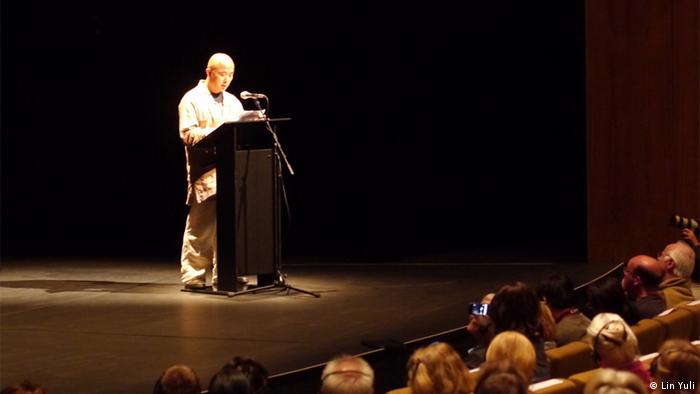 廖亦武在柏林文学节开幕式上发表演讲