----
末日刷屏(或稱「末日滾動」)是一種強迫性習慣,指人們沉迷於瀏覽負面新聞和社群媒體內容,即使這些內容會引發痛苦、焦慮或悲傷。這種習慣源自於神經系統固有的負面偏見,會形成一種因恐懼而產生的成癮循環,透過引發替代性創傷和壓力水平升高來損害心理健康。
AI Overview
Doomsday scrolling (or doomscrolling) is the compulsive habit of obsessively scrolling through negative news and social media content, even when it causes distress, anxiety, or sadness. Driven by a neurological negativity bias, it creates an addictive cycle of fear-driven engagement that harms mental health by triggering vicarious trauma and elevated stress levels. [1, 2, 3, 4, 5, 6]
- Negativity Bias: Human brains prioritize threats over neutral information, leading us to fixate on alarming headlines.
- The "Why" Factor: It is a, often futile, attempt to gain a sense of control over uncertainty, often driven by fear of missing out (FOMO).
- Algorithm Design: Social media platforms are optimized to keep the brain's threat-detection system activated, exploiting our need for novelty to keep us scrolling.
- Confirmation Bias: When feeling anxious or depressed, we seek out negative information to confirm our current mood. [1, 2, 3, 4, 5]
- Mental Health: It increases anxiety, panic, depression, and can lead to a sense of helplessness.
- Physical Health: Chronic consumption of distressing content can lead to physical symptoms like high blood pressure, fatigue, and lower immune system function.
- "Vicarious Trauma": Continuously watching graphic or tragic news can cause emotional distress similar to witnessing the event. [1, 2, 3, 4, 5]
- Set Rigid Time Limits: Use app timers, such as the [NYT "Times" app] or built-in phone settings, to restrict news consumption to specific, short windows, such as 30 minutes a day.
- Curate Your Feed: Actively unfollow or mute accounts that post constant negativity, and seek out positive news sources like [The Happy Broadcast].
- Set Physical Boundaries: Avoid checking your phone for at least 30–60 minutes after waking up and before sleeping.
- Practice "Joy Scrolling": Actively look for uplifting, educational, or creative content to disrupt the negative cycle.
- Focus on Local Action: Focus on things within your immediate sphere of influence rather than global issues you cannot control. [1, 2, 3, 4, 5]
《大西洋月刊》
· 喬納森·海特在紐約大學2026屆畢業典禮致詞中,敦促畢業生珍惜注意力,並用它來完成艱鉅的任務。 https://theatln.tc/iTs… 看更多
History
The concept of attention economics was first theorized by psychologist and economist Herbert A. Simon[12] when he wrote about the scarcity of attention in an information-rich world in 1971:
He noted that many designers of information systems incorrectly represented their design problem as information scarcity rather than attention scarcity, and as a result, they built systems that excelled at providing more and more information to people, when what was really needed were systems that excelled at filtering out unimportant or irrelevant information.[14]
Simon's characterization of the problem of information overload as an economic one has become increasingly popular in analyzing information consumption since the mid-1990s, when writers such as Thomas H. Davenport and Michael Goldhaber[15] adopted terms like "attention economy" and "economics of attention".[16]
Some writers have speculated that transactions based on attention will replace financial transactions as the focus of economic system. For example, Goldhaber wrote in 1997: "...transactions in which money is involved may be growing in total number, but the total number of global attention transactions is growing even faster."[17] For a 1999 essay, Georg Franck argued "income in attention ranks above financial success" for advertising-based media like magazines and television.[18] Information systems researchers have also adopted the idea, and are beginning to investigate mechanism designs which build on the idea of creating property rights in attention (see Applications).
In 2022, Rice University professor Adrian Lenardic and two co-authors wrote for BigThink that attention economics adversely affected scientific research: "The attention a scientist’s work gains from the public now plays into its perceived value. Scientists list media exposure counts on résumés, and many PhD theses now include the number of times a candidate’s work has appeared in the popular science press. Science has succumbed to the attention economy."[19] They add that study results are publicized without proper peer input or reproducibility.[19]
N.Y.U. Students Object to Speaker Who Calls Their Generation Coddled
Jonathan Haidt, a professor, says that colleges shield students from challenging ideas. But student leaders said he does not represent their values.
紐約大學學生反對一位稱他們這一代被嬌慣的演講者
教授喬納森·海特表示,大學保護學生免受挑戰性思想的影響。但學生領袖表示,他的觀點並不能代表他們的價值觀。

喬納森·海特因畢業典禮演說遭紐約大學學生強烈反對
海特對多元化、公平和包容性措施的批評。 (海特博士在2022年表示,他將退出一個專業協會,因為該協會要求其年會演講者披露他們的工作如何推進該協會的公平和反種族主義目標。)
學生們在信中表示震驚,紐約大學竟然找不到一位「學術成就和全球貢獻更能準確反映其畢業生價值觀和多元化」的演講者。他們指出,往年的演講嘉賓包括泰勒·斯威夫特、索尼婭·索托馬約爾大法官和律師大衛·博伊斯。
信中繼續寫道:“許多學生表示感到失望、厭惡、缺乏熱情、挫敗和尷尬”,並對原本值得慶祝的時刻“卻變成了又一次被誤解的事件”表示遺憾。
In their letter, the students expressed shock that N.Y.U. could not find a speaker “whose scholarship and global contributions more accurately reflect the values and diversity of its graduates.” In past years, they noted, speakers included Taylor Swift, Justice Sonia Sotomayor and the lawyer David Boies.
the letter went on, expressing regret that their celebratory moment had instead “become another instance of being misunderstood.”
書籍
焦慮的世代
這不是趣聞,這是焦慮世代的真實
前幾年,你可能讀過矽谷的科技人,不讓小孩過早接觸科技產品或社交媒體的報導,主要想避免自己的孩子陷入科技成癮或社交失能或焦慮的狀況。如今,幾年過去了,矽谷的科技人擔心的事情,成為人人在經歷的現實。特別在Z世代(1995-2010),他們與科技產品、工具並進成長,經歷著虛擬空間與欠缺豐富生活體驗的「大重塑的童年」。他們擁有連結最廣大世界的能耐,卻也成為最脆弱的一代。作者從統計數字中發現,從2010年代初,心理健康開始下滑的趨勢,包含在焦慮症、憂鬱症的患病率和自殘率都有顯著上升,其中對女孩的影響更為劇烈。科技工具的危險也擴及不同世代的人們,即使數據上並不明顯,但是因為新技術及其不斷的干擾和分散注意力,人們也變得更焦慮、思緒不集中以及筋疲力盡。透過此書作者呼籲社會大眾正視問題,並提供可能改善的建言以及行動方案,以找回人類的正常生活。
2024
正義之心:為什麼好人會因政治和宗教而分裂
2012
嬌慣的美國心靈
2018
幸福假設
2006
神奇的一代:螢幕世界中的樂趣與自由指南
2025
幸福假設:尋找幸福與人生意義的十種方法 2020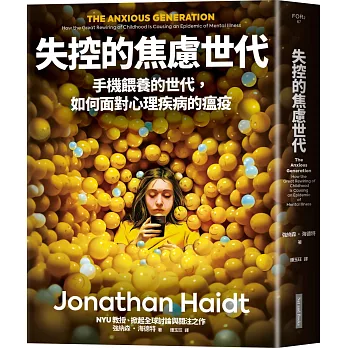
選書主題活動試閱
5
(52)
失控的焦慮世代:手機餵養的世代,如何面對心理疾病的瘟疫
The Anxious Generation: How the Great Rewiring of Childhood Is Causing an Epidemic of Mental Illness
可購買版本(2):電子書優惠價295元
平裝優惠價379元
作者: 強納森.海德特 新功能介紹
原文作者: Jonathan Haidt
譯者: 鍾玉玨
出版社:網路與書出版 新功能介紹
出版日期:2024/11/29
語言:繁體中文
gazmasr.com
Jonathan Haidt faces NYU student backlash over commencement speech
7 hours agodo
NYU Students Protest Jonathan Haidt as 2026 Commencement Speaker
The New York Times
N.Y.U. Students Object to Graduation Speaker Jonathan Haidt, Who Calls Their Generation ‘Coddled’
1 day ago
The College Fix
Students demand cancel culture critic Jonathan Haidt be canceled as NYU grad speaker
24 hours ago
More news
Books
The Anxious Generation
2024
The Righteous Mind: Why Good People Are Divided by Politics and Religion
2012
The Coddling of the American Mind
2018
The Happiness Hypothesis
2006
The Amazing Generation: Your Guide to Fun and Freedom in a Screen-Filled World
2025
The Happiness Hypothesis: Ten Ways to Find Happiness and Meaning in Life
2020

沒有留言:
張貼留言