很少有藝術家像侯賽因一樣遊歷廣泛,且擁有如此豐富的想像力。他筆下的馬匹——肌肉發達、充滿活力——至今仍是當代藝術中最受珍視、最具辨識度的畫作之一,售價高達數百萬美元。A new museum in Doha celebrates Indian art legend MF Husain
Zoya MateenDelhi
Qatar Foundation
A new museum in Doha is spotlighting the Indian artist's legacy in an imaginative way
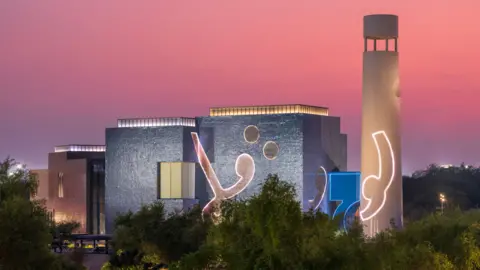
At the edge of Doha, a new grey-blue building rises like a drawing on its skyline, its shimmering tiles shifting with the sun and casting geometric shadows.
The building seems to be leaning forward, as if eager to tell a story.
In a video clip of Lawh Wa Qalam, the world's first museum dedicated to MF Husain, we see glimpses of the extraordinary work of the late legendary Indian artist, whose prolific paintings and turbulent personal history have fascinated the world.
The museum honours the legacy of the artist who spent his last years in Qatar and was granted citizenship in 2010.
Spanning over some 3,000 sq m, it opened to visitors last week and is part of the expansive campus of Qatar Foundation's Education City, an educational and research hub.
Inside, more than 150 works and objects - including paintings, sculptures, films, tapestries and photos - map the astonishing breadth of Husain's career, offering visitors a rare window into the artist's late-life reflections and inspirations.
Husain always wanted his museum to feel like home, says Noof Mohammed, the curator. "We want visitors to experience the world as he did, in an intimate, playful and reflective manner."
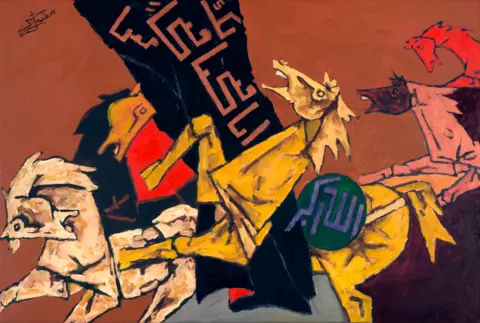
Few artists have travelled as widely, or imaginatively, as Husain. His horses - muscular and dynamic - remain some of the most prized and instantly recognisable paintings in contemporary art, sold for millions of dollars.
AFP via Getty Images
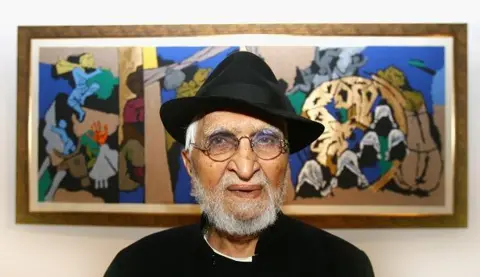
MF Husain is arguably one of the most famous Indian modernists
Qatar Foundation
He was especially known for painting dynamic horses with energetic brushstrokes and vivid colours
Ikuo Hirayama, in front of his Silk Road works (ASAHI SHIMBUN FILE PHOTO)
Ikuo Hirayama, a Japanese-style painter famous for his Silk Road series of works as well as his efforts to protect cultural heritage sites in Japan and overseas, died of a stroke Wednesday. He was 79.
During his 60-year career, Hirayama painted people, landscapes, and historical and cultural assets in a distinctive style marked by glowing colors, based on precise sketches, and imbued with a sense of grandeur, romance and the vastness of time.
He received the Order of Culture in 1998.
Among his many roles, he served as president of the Tokyo National University of Arts and Music (now Tokyo University of the Arts), chairman of the Japan Art Institute and a UNESCO goodwill ambassador.
Hirayama was born in Hiroshima Prefecture in 1930 and, after surviving the 1945 atomic bombing of Hiroshima city, grew ill at one time from a radiation-related illness. His experience of the cataclysmic attack apparently shaped his yearning for peace and respect for cultural heritage.
He studied Japanese painting under Seison Maeda at a predecessor of the arts university in Tokyo. He inherited Maeda's respect for the Orient, and valued traditional Japanese virtues.
Hirayama first received acclaim for a series of paintings based on Buddhist themes, such as "Bukkyo Denrai" (The Transmission of Buddhism) in 1959 and "Nyu-Nehan Genso" (Fantasy of Nirvana) in 1961.
His 1979 work "Hiroshima Shohen-zu" (The Holocaust of Hiroshima) avoids a direct portrayal of the atomic bombing, and depicts instead richly red flames that rise up to Acalanatha, a Buddhist deity who destroys delusion and rescues people.
But he is most famous for his paintings of Silk Road desert landscapes, people and history.
During the 1960s and 1970s, Hirayama took part in the restoration of the murals of Horyuji temple's main hall and of the ancient Takamatsuzuka tumulus.
He also contributed to the preservation and restoration of cultural heritage sites in several countries, such as the Angkor Wat ruins in Cambodia, the Buddhas of Bamiyan in Afghanistan--much of which were blown up by the Taliban in 2001.
He also donated 200 million yen to protect a cave-temple in Dunhuang, China.
From 1973, Hirayama served as a professor at his alma mater, where he taught up-and-coming artists. He served as president from 1989 to 1995, and again from 2001 to 2005.
He received the Ramon Magsaysay Award for Peace and International Understanding in 2001 and the Asahi Prize for fiscal 2003.
He was also chairman of the Japan-China Friendship Association, president of the Japan Scholarship Foundation and chairman of the Japanese National Commission for UNESCO.
Just as his lifelong passion, the Silk Road, connected the East and the West, Hirayama played a major role in connecting countries, sectors and peoples.(IHT/Asahi: December 3,2009)
Ikuo also has his career as the president of the university.
A hibakusha, he produced a series of paintings depicting the introduction of Buddhism to Japan. Later, he portrayed the A-bomb attack on Hiroshima. He is also active in the preservation of the cultural heritage of the world (for example, the Bamiyan Buddhas) and is internationally appreciated for his efforts in this sphere. Hirayama was awarded the Order of Cultural Merit in 1998.
He has a studio in Kamakura, Kanagawa. There is a dedicated museum in Setoda, having an English Web site at [1].
 Qatar Foundation
 AFP via Getty Images
 Qatar Foundation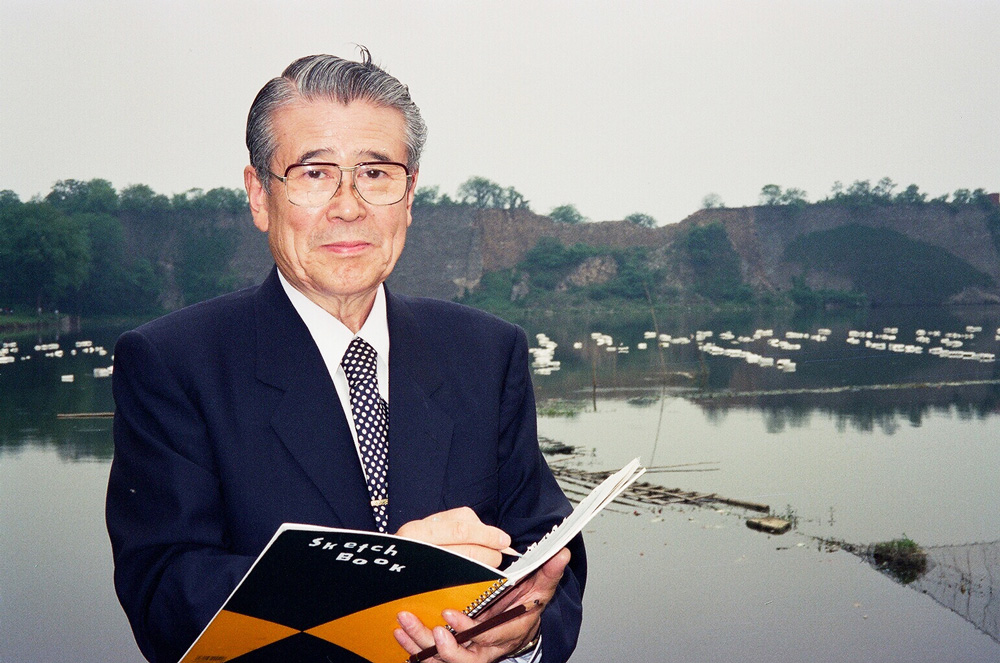
 自作の前で語る平山郁夫さん=07年2月26日
 2009年秋に開かれた再興第94回院展に出品された平山郁夫さんの日本画「文明の十字路を往く――アナトリア高原 カッパドキア トルコ」
 Ikuo Hirayama, in front of his Silk Road works (ASAHI SHIMBUN FILE PHOTO)

沒有留言:
張貼留言