Steven Pinker
https://stevenpinker.com/
Web site for Steven Pinker, Johnstone Professor of Psychology, Harvard University and author of books on language, mind, & human nature.https://www.ted.com/talks/steven_pinker_is_the_world_getting_better_or_worse_a_look_at_the_numbers
Steven Pinker
Viking (2018)
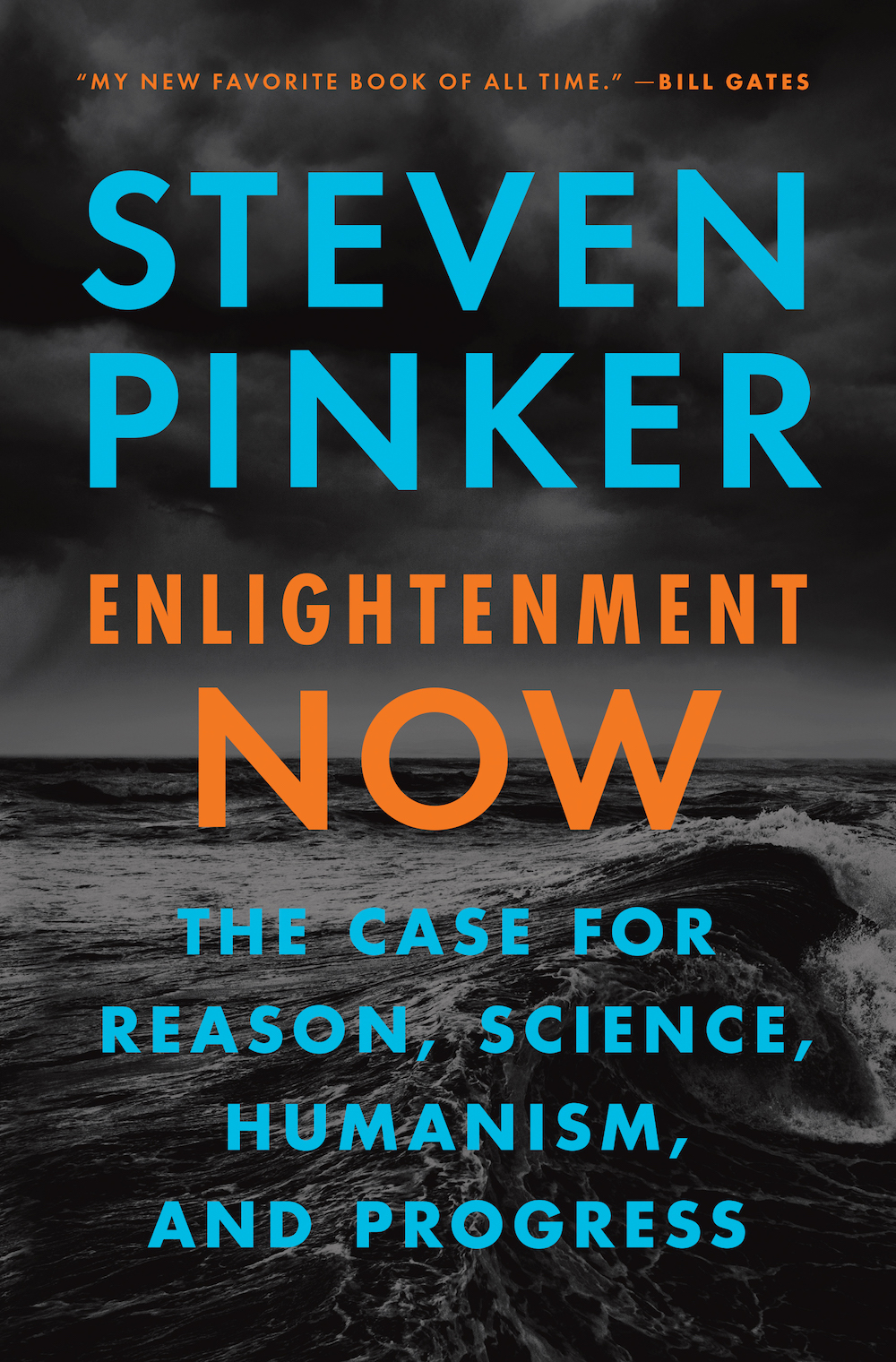

"One aspect of the book unlike anything that came out of the Enlightenment is the use of data as a basic component of the argumentation. It’s not that I think Enlightenment figures would have found this mode of argument alien. On the contrary, the use of graphs to visualize data was itself an Enlightenment innovation."

https://www.ft.com/content/926a66b0-8b49-11e8-bf9e-8771d5404543
Henry Kissinger: ‘We are in a very, very grave period’ The grand consigliere of American diplomacy talks about Putin, the new world order — and the meaning of Trump Share on Twitter (opens new window) Share on Facebook (opens new window) Share on LinkedIn (opens new window) Save Save to myFT Edward Luce JULY 20, 2018 Print this page725 It was not hard to entice Henry Kissinger to meet for lunch. Though he is 95, and moves very slowly, the grand consigliere of American diplomacy is keen to talk. He hops on and off planes to see the likes of Russia’s Vladimir Putin and China’s Xi Jinping with as much zeal as when he played the global chess game as Richard Nixon’s diplomatic maestro. He loves to be in the thick of things. Persuading him to say what he actually thinks is another matter. Kissinger is to geopolitical clarity what Alan Greenspan was to monetary communication — an oracle whose insight is matched only by his indecipherability. It is my mission to push him out of his comfort zone. I want to know what he really thinks of Donald Trump. The timing is perfect. We are having lunch the day after Trump met Putin in Helsinki — a summit that America’s foreign-policy establishment believes will go down as a low point in US diplomacy. Trump had done the unthinkable by endorsing Putin’s protestations of innocence of electoral sabotage over the word of America’s intelligence agencies. Later today Trump will unconvincingly try to undo what he said in Helsinki by insisting he meant “wouldn’t” instead of “would”. But it is too late for that. The New York Daily News has the screaming headline: “Open Treason” next to a cartoon of Trump shooting Uncle Sam in the head while holding Putin’s hand. There could be no better moment to jolt Kissinger off his Delphic perch. I arrive with a minute or two to spare. Kissinger is already seated. He cuts a gnomish figure at a corner table in a half-empty dining room. A large walking cane is propped against the side wall. (He tore a ligament a few years ago.) “Forgive me if I don’t get up,” says Kissinger in his gravelly German accent. We are at the Jubilee, a cosy French restaurant just around the corner from Kissinger’s Midtown Manhattan apartment. It is only a few blocks from Kissinger Associates, the geopolitical consultancy that charges clients princely sums to hear what I assume are his unvarnished thoughts. My only inducement is a nice lunch. When we order, Kissinger checks whether he is my guest. “Ah yes,” he says, chortling after I insist he is. “Otherwise that would be corruption.” He eats here often. “I had dinner here just last night with my daughter,” he says. On two or three occasions, someone comes over to shake his hand. “I am the Ukrainian ambassador to the UN,” says one. “Who?” says Kissinger. “Ukraine,” the diplomat replies. “We think very highly of you.” Kissinger’s face lights up. “Ah Ukraine,” he says. “I am a strong supporter.” Geopolitics weighs heavily on Kissinger. As the co-architect of the cold war rapprochement with China and détente with the Soviet Union, Kissinger now surveys a world in which China and Russia are both challenging the US world order, often in concert with each other. But the doyen of cold war diplomacy is as interested in the future as he is in the past. This year Kissinger wrote a terrifying piece on artificial intelligence for The Atlantic Monthly, in which he compared humanity today to the Incas before the arrival of smallpox and the Spanish. He urged the creation of a presidential commission on AI. “If we do not start this effort soon, before long we shall discover that we started too late,” he concluded. This summer Kissinger is working from home on a book about great statesmen and women (there is a chapter on Margaret Thatcher). He has just finished a section on Nixon, the president whom he served — uniquely — both as secretary of state and national security adviser. It is 25,000 words long and Kissinger is toying whether to publish it separately as a short book. He worries it will backfire. “It might bring all the contestants out of their foxholes again,” he says. Do you mean that it could provoke comparisons between Watergate and Trump’s Russia investigation, I ask. “That is my fear,” he replies. Before I have a chance to follow up, Kissinger switches to Thatcher. “She was a magnificent partner,” he says. “I am a believer in the special relationship because I think America needs a psychological balance and this is a natural one based on history — not just on contributions.” Our starters arrive. Kissinger has a plate of chicken liver pâté, which he consumes with gusto. He has tucked his napkin bib-style into his upper shirt. I want to talk about Trump. Kissinger is keen to stay on Britain. I ask him about Lord Carrington, the former British foreign secretary, who resigned in 1982 to carry responsibility for failing to stop Argentina’s invasion of the Falkland Islands, and who died, aged 99, this month. On the day of Carrington’s death, Boris Johnson, the most recent British foreign secretary, quit with very different motives. You could say the first resigned with honour and the second with dishonour. “I loved Lord Carrington,” says Kissinger with feeling. “I never went to England without seeing him.” In all their years of friendship, Carrington did not once complain about having to resign, says Kissinger. “He said to me: ‘What is the point of assuming responsibility if you then whisper to your friends that you are not really responsible?’ I don’t think we have that quality any more because for that you need a tradition that you take for granted and we no longer can.” Johnson certainly doesn’t embody it, I suggest. “I don’t think Carrington thought much of Johnson,” Kissinger replies. What did Kissinger make of the Helsinki summit? His answer is halting. I think Trump may be one of those figures in history who appears from time to time to mark the end of an era and to force it to give up its old pretences “It was a meeting that had to take place. I have advocated it for several years. It has been submerged by American domestic issues. It is certainly a missed opportunity. But I think one has to come back to something. Look at Syria and Ukraine. It’s a unique characteristic of Russia that upheaval in almost any part of the world affects it, gives it an opportunity and is also perceived by it as a threat. Those upheavals will continue. I fear they will accelerate.” Kissinger embarks on a disquisition about Russia’s “almost mystical” tolerance for suffering. His key point is that the west wrongly assumed in the years before Putin annexed Crimea that Russia would adopt the west’s rules-based order. Nato misread Russia’s deep-seated craving for respect. “The mistake Nato has made is to think that there is a sort of historic evolution that will march across Eurasia and not to understand that somewhere on that march it will encounter something very different to a Westphalian [western idea of a state] entity. And for Russia this is a challenge to its identity.” Do you mean that we provoked Putin, I ask. “I do not think Putin is a character like Hitler,” Kissinger replies. “He comes out of Dostoyevsky.” Our main courses arrive. Kissinger has ordered branzino on a bed of green vegetables. He barely touches the dish. “No, but it was very good,” he says later when the waitress offers to pack it into a box. By contrast, I eat most of my Dover sole and Brussels sprouts. We are both drinking Badoit sparkling water, which Kissinger has specifically requested. I sense I am losing my battle to get him on to Trump — or failing to detect his hidden message. Is he saying we are underestimating Trump — that, in fact, Trump may be doing us the unacknowledged service of calming the Russian bear? Again, there is a pause before Kissinger answers. “I don’t want to talk too much about Trump because at some point I should do it in a more coherent way than this,” Kissinger replies. But you are being coherent, I protest. Please don’t stop. There is another pregnant silence. “I think Trump may be one of those figures in history who appears from time to time to mark the end of an era and to force it to give up its old pretences. It doesn’t necessarily mean that he knows this, or that he is considering any great alternative. It could just be an accident.” By now Kissinger has abandoned his halfhearted stabs at the fish. I know he has briefed Trump. He has also met Putin on 17 occasions. He reports the contents of those meetings to Washington, he tells me. I try a different tack. To whom does Trump compare in history, I ask. This also fails to do the trick. Kissinger goes off on a tour d’horizon of the health of European diplomacy. He can find no leader who excites him, with the possible exception of France’s Emmanuel Macron. “I can’t yet say he’s effective because he’s just started but I like his style,” says Kissinger. “Among other European statesmen, Angela Merkel is very local. I like her personally and I respect her but she’s not a transcendent figure.” Which diplomatic brain would he compare in today’s US establishment to himself, say, or the late Zbigniew Brzezinski — his former sparring partner, who also served as national security adviser? The mention of Brzezinski triggers something. “When Zbig died, which was a great surprise, I wrote to his wife that no death has moved me quite as much as his,” Kissinger says, again with evident feeling. “Zbig was almost unique in my generation. We both considered ideas about the world order to be the key problem of our time. How could we create it? We had somewhat different ideas. But for both of us, we were above all concerned to raise diplomacy to that level of influence.” Who is asking those questions today, I ask. “There is no debate today,” Kissinger replies. “It is something we need to have.” I cannot shake the feeling that Kissinger is trying to tell me something but that I am too literal to interpret it. Like a blindfolded darts player, I try a number of different throws. What would Germany become if Trump pulled America out of Nato? Kissinger likes that question but declines to give odds as to its likelihood. “In the 1940s, the European leaders had a clear sense of direction,” he says. “Right now they mostly just want to avoid trouble.” They are not doing a very good job of it, I interrupt. “That’s true,” says Kissinger with a cryptic smile. “One eminent German recently told me that he always used to translate tension with America as a way to move away from America but now he finds himself more afraid of a world without America.” So could Trump be shocking the rest of the west to stand on its own feet, I ask. “It would be ironic if that emerged out of the Trump era,” Kissinger replies. “But it is not impossible.” The alternative, Kissinger adds, is not appealing. A divided Atlantic would turn Europe into “an appendage of Eurasia”, which would be at the mercy of a China that wants to restore its historic role as the Middle Kingdom and be “the principal adviser to all humanity”. It sounds as though Kissinger believes China is on track to achieve its goal. America, meanwhile, would become a geopolitical island, flanked by two giant oceans and without a rules-based order to uphold. Such an America would have to imitate Victorian Britain but without the habit of mind to keep the rest of the world divided — as Britain did with the European continent. Kissinger is more circumspect on AI — a subject, he concedes, with which he is still grappling. But he is troubled by the unknown consequences of autonomous warfare — a world in which machines are required to take ethical decisions. “All I can do in the few years left of me is to raise these issues,” he says. “I don’t pretend to have the answers.” JUBILEE 948 1st Avenue, New York Pâté $13.50 Pea soup $11.00 Branzini $31.50 Dover sole $57.00 Bottle of sparkling water $8.50 Tea $4.50 Double espresso $9.00 Total (inc tax & tip) $176.00 I have little idea how Kissinger will take my next question. Is power an aphrodisiac? “What was the word?” Kissinger asks. “Aphrodisiac,” I repeat. I am quoting the famous Kissinger line that he made in the heyday of his career when he was still a single man. In the late 1960s and early 1970s he was as much known for his racy dating calendar as for affairs of state. “I would certainly say that being able to make decisions has a dimension that you don’t have in ordinary life,” Kissinger replies with the hint of a smile. That was a subtle answer, I tell him. “I did say that,” he replies. “But when I say these things they’re more intended to establish your cleverness than your life’s purpose. And it’s true to some extent. It is based on observation.” By now we are on to the coffee. Mine is a double espresso. Kissinger has mint tea. I decide to take a final stab at the bullseye. We have been talking for almost two hours. If there is one recurring criticism of Kissinger, I tell him, it is that he goes to great lengths to preserve access to people in power at the expense of not speaking plainly in public. Isn’t now — of all moments — the right one to burn a bridge or two? Kissinger looks crestfallen. “I take that seriously and a lot of people, good friends of mine, have been urging this on me,” he says eventually. “It could happen at some point in time.” There is no time like the present, I say with a nervous laugh. “It is clear the direction I am going in,” he replies. “Is it clear to you?” Sort of, I reply. You are worried about the future. However, you believe there is a non-trivial chance that Trump could accidentally scare us into reinventing the rules-based order that we used to take for granted. Is that a fair summary? “I think we are in a very, very grave period for the world,” Kissinger replies. “I have conducted innumerable summit meetings, so they didn’t learn this one [Helsinki] from me.” It is clear he will not elaborate further. I ask him which period he would liken to today. Kissinger talks about his experience as a freshly minted citizen in US uniform serving in the second world war. He also reminisces about what brought the young German refugee to these shores in the first place. After Germany marched into Austria in 1938, Jews in Kissinger’s home town were told to stay indoors. His parents left for America when they could. “There was a curfew and German soldiers everywhere,” he says. “It was a traumatic experience that has never left me.” His reminiscence is carefully chosen. Something like a biblical storm has descended since we sat down. One umbrella literally flew past the window. I help Kissinger through the soaking whiplash to his car. The driver takes his other arm. He is unsteady. I realise that I have been ungraciously interrogating a man almost twice my age. “Dr Kissinger has been looking forward to this lunch for days,” says the server after I return to borrow an umbrella. That is nice, I think — though I fear my Trump questions may have depressed his appetite. Edward Luce is the FT’s US national editor and author of ‘The Retreat of Western Liberalism’