“I am brutal, naïve and Gothic,” he told Artforum in 1995. “I was born into a destroyed order, a destroyed landscape, a destroyed people, a destroyed society. And I didn’t want to reestablish an order: I’d seen enough so-called order. I was forced to question everything, to be ‘naïve,’ to start again.”
Georg Baselitz (1938- 2026)
Georg Baselitz 80歲 (2018);donated seven works to the museum in Munich
https://hcpeople.blogspot.com/....../2025-1026-massive......
然而第一次世界大戰的敗績、威瑪共和國的崩潰,以及「第三帝國」的謀殺罪行,已經使得此類具有一致連貫性的論述變成不可能。德國學者們徒勞無功地想把一塊拼圖的不同部分組合在一起,但沒有人能夠以令人信服的方式,把十八、十九世紀德國在思想上和文化上的偉大成就與納粹的道德淪喪連接起來,拼湊出一個可讓人理解的圖像。就深層意義而言,這種歷史已經滿目瘡痍到了無法修復的地步,以致必須不斷地重新審視──此種構想已被格奧爾格.巴塞利茨(Georg Baselitz)那一面破爛不堪、混亂倒置的國旗,強而有力地加以視覺化。
亮麗、多彩、快樂的顏色(Happy Color),像是Georg Baselitz有著紅、橘、黃色調的倒立人像,更時常伴隨他的差旅生活穿梭於不同空間,增添朝氣與活力。
在德國,新歐洲畫家或直接或間接地關注戰後歐洲的問題。歐洲社會的古老結構該如何重建?朋友和家人扮演怎樣的角色?短暫的愛情能否賦予我們自我認同感?或者,白日夢才是更好的指引?日常事物能否教我們一些東西?如果可以,又該如何透過繪畫來表達?
格奧爾格·巴塞利茨(Georg Baselitz)正是思考這些問題的藝術家之一。他原名格奧爾格·克恩(Georg Kern),1938年出生於薩克森州一個名為德意志巴塞利茨(Deutschbaselitz)的小村莊。薩克森被蘇聯佔領後,他留在東德,直到成年後才搬到柏林。他立志從事藝術創作,為了留作紀念,他取了出生地名字的一半,並進入了這座昔日德國首都的藝術院校學習。
美國國家美術館
格奧爾格·巴塞利茨被譽為具象繪畫復興的先驅,也是所謂國際新表現主義運動的創始人之一。在1950年代末,巴塞利茨開始發展他獨特的具象繪畫風格,挑戰了20世紀抽象藝術的正統觀念。 1965年至1966年間,巴塞利茨創作了一系列他稱之為「英雄」(Helden)系列的畫作,其中《月亮上的男人-弗朗茨·普福爾》便是早期代表作。
IN GERMANY, THE NEW EUROPEAN Painters have addressed themselves directly or indirectly to the problems of postwar Europe. How can the ancient structures of European society be put back into repair? What is the role of friends and family? Can short-lived amours give us a sense of our own identity? Or is the daydream a better guide? Can everyday things have something to teach us? If so, how can that something be set out in painting?
Someone who has tussled with these questions is Georg Baselitz, who was born Georg Kern in 1938 in a village called Deutschbaselitz in Saxony. After Saxony was overrun by the Russians, he stuck it out in the East until he was old enough to move to Berlin. Bent on making art, he took half the name of his birthplace, by way of a keepsake, and enrolled in the art schools of the former German capital.
National Gallery of Art
Georg Baselitz has come to be regarded as a pioneer in the renewal of figurative painting and as a founder of the so-called international neo-expressionist movement. In the late 1950s Baselitz began to develop his own style of figurative painting, challenging the orthodoxy of abstraction in the twentieth century. Baselitz produced a group of paintings from 1965 to 1966, which he called his Helden or Hero paintings, of which “Man in the Moon—Franz Pforr” is an early example.

Georg Baselitz - Wikipedia, the free encyclopedia
en.wikipedia.org/wiki/Georg_Baselitz
Georg Baselitz (born 23 January 1938) is a German painter. He studied in East Germany, before moving to what was then West Germany. Baselitz's style is ...
In October 1963, the work, as well as the picture Der nackte Mann, shown in the West Berlin gallery Werner & Katz, was seized by the public prosecutor's office because ofimmorality. The criminal proceedings ended in 1965 with the return of the pictures.[citation needed]
Die große Nacht im Eimer

Artist Georg Baselitz
Year 1963
Type oil on canvas
Dimensions 250 cm × 180 cm (98 in × 71 in)
Location Museum Ludwig, Cologne
MoMA | The Collection | Georg Baselitz (German, born 1938)
www.moma.org/collection/artist.php?artist_id=366
German painter, draughtsman, printmaker and sculptor. After attending grammar school in Kamenz, near Dresden, he began studying painting at the ...
http://www.britishmuseum.org/whats_on/exhibitions/germany_divided.aspx
Germany divided
Baselitz and his generation
From the Duerckheim Collection
6 February – 31 August 2014
Free
Room 90 /Open late Fridays
Featuring over 90 extraordinary drawings and prints, this exhibition explores how six key post-war artists redefined art in Germany on both sides of the Iron Curtain.
All the artists in this exhibition came originally from eastern Germany and migrated to the West, the majority before the borders were sealed in 1961. Some had trained in East Germany, but it was in the West that their careers were established. As a generation, they came out of the experience of growing up in the aftermath of a Germany defeated in the Second World War, and its subsequent partition in 1949.
Much of their work is informed by the sense of collective guilt experienced by the German people over its recent past, the country’s physical and psychological destruction, and the division of the country by two opposing ideologies – the democracies of the free West and the Communist system of the Soviet bloc.
These remarkable works on paper, on public display for the first time, are on loan from the private collection of Count Christian Duerckheim. Half of them are by Georg Baselitz, with the remainder by Markus Lüpertz, Blinky Palermo, A R Penck, Sigmar Polke and Gerhard Richter. 34 of the works in the exhibition, including 17 by Baselitz, have been generously donated to the British Museum by Count Duerckheim.
The gift includes a group of 11 drawings by Baselitz from 1960 to the late 1970s, together with prints from the same period. They cover the principal phases of his career from the Pandemonium drawings of the early 1960s, the development of his ironic ‘Heroes’ in the mid-1960s, and the subsequent fracturing of his motifs to the eventual inversion of the motif from the late 1960s.
Other works on display include Richter’s Pin-up andInstallation drawings, the characteristic Ice Age-meets-cybernetics stick-figures of Penck, as well as sculptural drawings by Lüpertz and Palermo, and a drawing and sketchbook by Polke satirising the ‘economic miracle’ of post-war reconstruction in West Germany.
The donation completely transforms the Museum’s holdings of German post-war graphic art and enables the Museum to trace the history of drawings and printmaking in Germany from the time of Dürer to the present.

Ein neuer Type('A New Type'), 1965, Georg Baselitz (b.1938), grey and yellow ochre watercolour, charcoal, graphite and white pastel on paper. Presented to the British Museum by Count Christian Duerckheim, Reproduced by permission of the artist. © Georg Baselitz PreviousNext
1 of 6
Catalogue

Germany Divided: Baselitz and his generation
This title was published in January 2014 and includes 130 beautiful colour illustrations. Available in hardback with jacket.
Georg Baselitz: 'Am I supposed to be friendly?'
 Email
Email
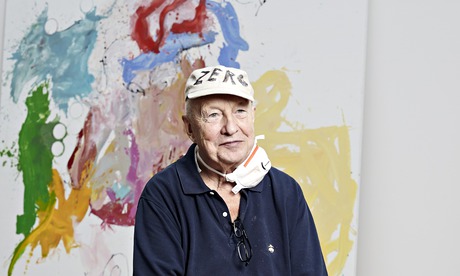
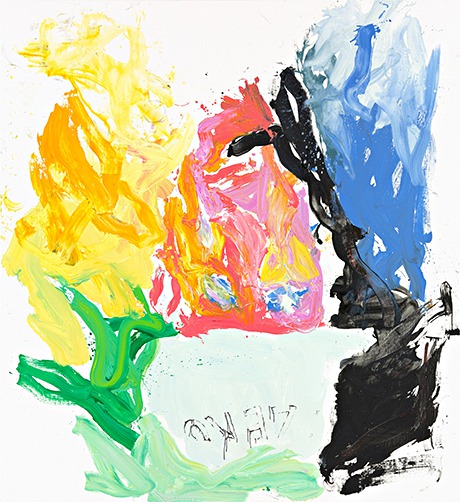 Licht wil raum mecht hern. Copyright Georg Baselitz. Courtesy of the Gagosian Gallery Photograph: georg baselitz
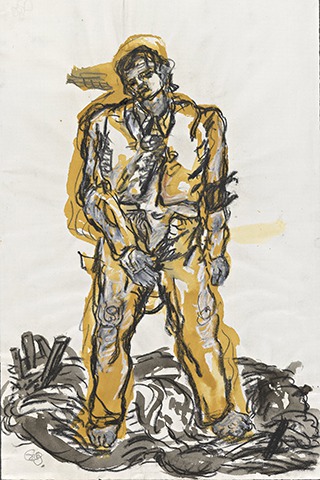 A New Type. Copyright Georg Baselitz. Courtesy of the British Museum
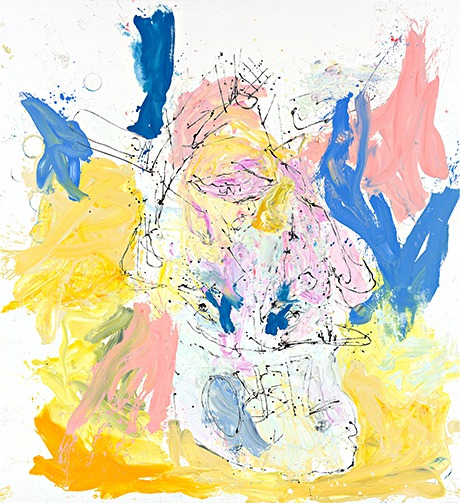 Willem raucht nicht mehr. Copyright Georg Baselitz. Courtesy of the Gagosian Gallery Photograph: Georg Baselitz
沒有留言:
張貼留言