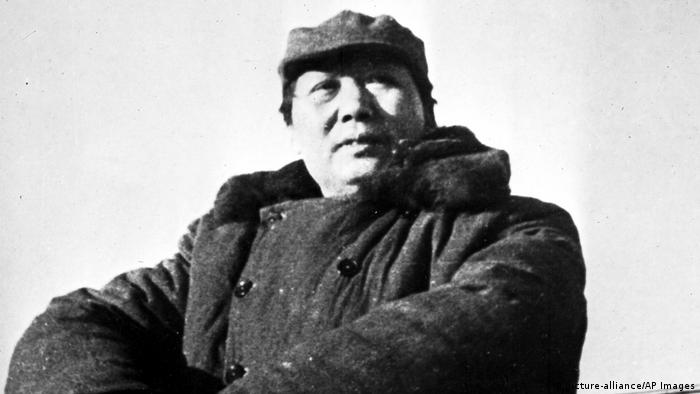
September 10, 1976
OBITUARY
Mao Tse-Tung: Father of Chinese Revolution
By Fox Butterfield
Special to The New York Times
HONG KONG, Sept. 9--Mao Tse-tung, who began as an obscure peasant, died one of history's great revolutionary figures.
Born at a time when China was wracked by civil strife, beset with terrible poverty and encroached on by more advanced foreign powers, he lived to fulfill his boyhood dream of restoring it to its traditional place as a great nation. In Chinese terms, he ranked with Chin Shih-huang, the first Emperor, who unified China in 221 B.C., and was the man Chairman Mao most liked to compare himself to.
With incredible perseverance and consummately conceived strategy, he harnessed the forces of agrarian discontent and nationalism to turn a tiny band of peasants into an army of millions, which he led to victory throughout China in 1949 after 20 years of fighting. Along the way the army fought battles as big as Stalingrad and suffered through a heroic march as long as Alexander's.
Then, after establishing the Chinese People's Republic, Mao launched a series of sweeping, sometimes convulsive campaigns to transform a semifeudal, largely illiterate and predominantly agricultural country encompassing almost four million square miles and a fifth of the world's population into a modern, industrialized socialist state. By the time of his death China had manufactured its own nuclear bombs and guided missiles and had become a major oil producer.
With China's resurgence, Mao also charted a new course in foreign affairs, putting an end to a century of humiliation under the "unequal treaties" imposed by the West and winning new recognition and respect. Finally, in 1972, even the United States abandoned its 20 years of implacable hostility when President Richard M. Nixon journeyed to Peking, where he was received by a smiling Mao.
At the same time he brooked no opposition to his control. To consolidate his new regime in the early 50's he launched a campaign in which hundreds of thousands were executed. In the late 50's, despite criticism from other party leaders, he ordered the Great Leap Forward, ultimately causing widespread disruption and food shortages. Throughout his years in power he toppled one of his rivals after another in the party. In the Cultural Revolution he risked throwing the country into chaos.
While China achieved enormous economic progress under Mao, some critics felt his constant political campaigns and his emphasis on conformity finally reduced many Chinese to a dispirited, anxious mass ready to go along with the latest shift in the political wind.
Complex Figure
One of the most remarkable personalities of the 20th century, Mao was an infinitely complex man-- by turns shrewd and realistic, then impatient and a romantic dreamer, an individualist but also a strict disciplinarian. His motives seemed a mixture of the humanitarian and the totalitarian. He himself once commented that he was "part monkey, part tiger," and perhaps after all he was riven with the same contradictions he was fond of analyzing in the world around him.
A Chinese patriot, a combative revolutionary, a fervent evangelist, a Marxist theorist, a soldier, a statesman and poet, above all Mao was a moralist who deeply believed, as have Chinese since Confucius, that man's goodness must come ahead of his mere economic progress. Like many Chinese of the past 100 years, angered by the insults of imperialism, he wanted to tear China down to make it stronger. He envisioned creating in China an egalitarian, revolutionary utopia in which mass enthusiasm provided the motive force.
"I have witnessed the tremendous energy of the masses," Mao wrote in 1958 in the midst of the Great Leap Forward, one of his biggest but ultimately most disruptive campaigns. "On this foundation it is possible to accomplish any task whatsoever." The two sentences are a striking summary of his thought.
Unlike many great leaders, Mao never exercised, or sought, absolute control over day-to-day affairs. But the man who rose from humble beginnings in a Hunan village became virtually sovereign, if not a living god, to the 800 million Chinese. His very words were the doctrine of the state. Printed in millions of little red plastic-bound books as "Quotations from Chairman Mao Tse- tung,"they were taken to possess invincible magic properties.
Power, Prestige and Anxieties
Although Mao was a devoted Leninist who, like his Russian predecessor, stressed the need for a tightly organized and disciplined party, he came to cast himself above his party and sought to replace it with a personal cult when it thwarted him.
Despite awesome power and prestige, in the later years of his life--from about 1960 onward--he seemed obsessed by anxieties that the Chinese revolution was in danger of slipping back into the old elitism and bureaucratic ways of imperial China. This danger appeared all the greater, in his eyes, because of the concurrent development in the Soviet Union of what he termed "revisionism." In Mao's view, Nikita S. Krushchev's emphasis on material incentives to increase consumer- oriented production and the clear emergence of a privileged party elite were anathema. Looking at the problems in China, Mao complained in 1964, with perhaps characteristic exaggeration, "You can buy a branch secretary for a few packs of cigarettes, not to mention marrying a daughter to him."
To revitalize China, to cleanse the party and to insure that the revolution survived him, Mao launched the Great Proletarian Cultural Revolution in 1966. As he conceded later, it had consequences even he did not foresee.
Party Unity Undermined
Hundreds of thousands of youngsters were mobilized as Red Guards. Often unruly, given to fighting among themselves, they roamed the country and humiliated and chastised Mao's opponents in the party after his call to "bombard the headquarters." After two years of turmoil, economic disruption and even bloodshed, order was finally restored, with help from the increasingly powerful army under Lin Piao, then Minister of Defense, and some surviving party leaders of a less radical bent such as Prime Minister Chou En-lai.
But Mao had severely undermined the critical and long-standing unity of the party, forged in the 1930's during the epochal Long March--an anabasis of 6,000 miles that took the fledgling army over mountains, rivers and wastelands from Kiangsi, in South China, to Shensi, in the northwest. Foremost among those purged in the Cultural Revolution were Liu Shao-chi, head of state, and Teng Hsiao-ping, the Secretary General of the party, who were labeled "capitalist roaders." Mr. Liu, for years one of Mao's closest associates, had served as head of state since 1959, when Mao relinquished the post in order to give his potential successors more experience. Mao's only official post after that was Chairman of the Chinese Communist Party's Central Committee.
Marshal Lin, for his role in keeping the army behind Mao and his constant and fulsome praise, was termed "Comrade Mao Tse-tung's close comrade in arms and successor" and his inheritance was engraved in the 1969 party constitution. But Marshal Lin lasted only two years; according to the official version, he died in a plane crash in Mongolia in 1971 after trying to escape to the Soviet Union when his plot to kill Mao was discovered. Even more bizarre, Mao insisted in letters and speeches that have since reached the outside world that he had been suspicious of Marshal Lin as early as 1966 and had used him only to help get rid of Mr. Liu.
For several years after Marshal Lin's death, the redoubtable Mr. Chou, a master administrator and conciliator, helped the visibly aging Mao lead the country and embark on what seemed a sustained period of economic growth. But Mr. Chou's death from cancer in January 1976 left the daily leadership in the hands of Mr. Teng, the former party Secretary General whom Mr. Chou resurrected in 1973, evidently with Mao's approval, and installed as senior Deputy Prime Minister and likely successor.
An Even Quicker Fall
Mr. Teng then fell victim to Mao's suspicions even more quickly than had Mr. Liu and Marshal Lin. Only three months after Mr. Chou's demise, Mr. Teng was stripped of his posts, castigated once again as a "capitalist-roader within the party" and accused by Mao of misinterpreting his personal directives by overstressing economic development.
In these later years there were some who thought that Mao appeared as an aging autocrat, given more and more to whim. His invitation last winter to Mr. Nixon to revisit Peking, the scene of his greatest triumph as President, was viewed as a possible sign of a man becoming divorced from reality, though it was understandable in Chinese terms as a kind gesture to a good friend.
Mao made his last public appearance in 1971; in published photographs since then he often looked like a sick man. His apparent difficulty in controlling the movement of his hands and face and his slurred speech stirred speculation that he had suffered a stroke or had Parkinson's disease.
Yet he continued to receive a succession of foreign visitors in his book-lined study, sitting slouched down in a tartan-covered chair, and he apparently remained active in the political conflict that divided Peking. One of his last acts, it was said, was to select a final successor, Hua Kuo-feng, a relative unknown who had spent his early party career in Mao's home district, Hsiang-tan, in Hunan. Whether the two men had a close personal relationship was not clear.
Rift With Moscow
In recent years Mao had also been preoccupied with China's monumental quarrel with the Soviet Union, one of the pivotal developments of the postwar world. From the Chinese side the conflict was partly doctrinal, over Mao's concern that Soviet revisionism was a dangerous heresy that threatened to subvert the Chinese revolution. It was partly political and military, concerned with Mao's effort first to resist Moscow's domination of the Chinese party and later to defend against Soviet troops on China's border. It was partly territorial, over Peking's contention that Czarist Russia had annexed Chinese territory.
Although few outsiders perceived it until the quarrel surfaced in the early 1960's, it is clear now that the trouble had its origin in the earliest contact between the Chinese Communists and the Russians in the 1920's. It was a period when Mao and others in the newly organized Chinese party were groping for a way to power, and Stalin, from the distance of Moscow gave them orders that repeatedly led them into disaster.
Stalin and his representatives from the Communist International who served as advisers in China-- Mao dubbed them "imperial envoys"--first directed the Communists to ally with Chiang Kai-shek's Nationalists. Then, after Generalissimo Chiang turned on the Communists in 1927, massacring thousands, Stalin ordered the party to anticipate a "revolutionary upsurge" in the cities by the (largely nonexistent) proletariat.
Mao was shorn of his posts and power in the early 1930's as a result of direct Soviet interference. It was only after the Communists were forced to begin the Long March in 1934, after more errors in strategy, that Mao won command because of his genius for organizing and leading peasant guerrillas in a revolution in the countryside.
His First Journey Abroad
When Mao traveled triumphantly to Moscow--it was his first journey abroad--at the end of 1949, soon after setting up his government, he immediately ran into the first foreign policy crisis of the People's Republic of China in the form of a two-month argument with Stalin over terms of an aid agreement and Soviet concessions. Although Mao was to try the Soviet model of economic development, with its emphasis on heavy industry, for a few years, by the mid-1950's he came to have doubts about it, both for its utility in a basically agricultural country such as China and because of the bureaucratic, elitist and capitalistic tendencies--material incentives--it brought with it.
A series of events in the mid- and late-1950's turned this history of uneasy relations into bitter wrangling and eventually open armed clashes. First among these was Nikita S. Khrushchev's speech in 1956 denouncing Stalin for his brutality and personality cult. Mao, who by then envisioned himself as the world's major Marxist-Leninist thinker and revolutionary, was caught by surprise. He resented not being consulted, and he was put in an awkward position by revelations by Mr. Khrushchev, then the party leader.
There followed in rapid succession the evident Soviet complicity in the affair of Peng Teh-huai, the Chinese Defense Minister who was purged in 1959 after criticizing Mao for the chaos of the Great Leap Forward: Moscow's failure to support Peking in a border clash with India, the offshore islands crisis with Taiwan and Washington, and finally the abrupt withdrawal of all Soviet technicians in July 1960, canceling hundreds of agreements to build factories and other installations.
At the same time Mr. Krushchev labeled the Chinese leaders as madmen in a speech to the Rumanian Party congress, and Mao was soon to tell his colleagues that "the party and state leadership of the Soviet Union have been usurped by revisionists."
The conflict reached its climax in the winter of 1969, when Soviet and Chinese patrols clashed along the frozen banks of the Ussuri River. Thereafter the Russians continued to build up their army, navy and air force along the Chinese frontier until a fourth of their troops were stationed in the area.
Mao spent hours lecturing every visiting head of state on the danger of Soviet expansionism-- hegemonism, as he termed it. His belief that Soviet "social-imperialism" was the greatest threat to peace enabled him to take a more sanguine view of the United States and helped bring about the gradual improvement in relations after 1972.
An Austere Style
Although Mao commanded enormous authority--in 1955, in a casual talk with local officials, he overturned the provisions of the five-year plan fixed only a day before by the National People's Congress--he shunned the trappings of might. He seldom appeared in public, perhaps to preserve a sense of awe and mystery, and he eschewed fancy dress or medals, in conformity with the simple standard he himself had set during his guerrilla days. Whatever the occasion, he wore only a plain gray tunic buttoned to the neck and trousers to match that came to be called a Mao suit in the West and for a period in the 1970's became a fashion craze.
Edgar Snow, the American journalist who in 1936 became the first Westerner to meet Mao, felt that his style owed much to the simplicity, if not roughness and crudeness, of his peasant upbringing. He had the "personal habits of a peasant, plain speaking and plain living," Mr. Snow reported after a visit to the Communists' guerrilla headquarters in Shensi, near Yenan. Mao was completely indifferent to personal appearance; he lived in a two-room cave like other peasants "with bare, poor, map-covered walls." His chief luxury was a mosquito net, Mr. Snow found, and he owned only his blankets and two cotton uniforms.
"Mao's food was the same as everybody's, but being a Hunanese he had the southerner's ai-la, or love of pepper," Mr. Snow wrote. "He even had pepper cooked into his bread. Except for this passion, he scarcely seemed to notice what he ate."
In the classic "Red Star Over China," the first public account of Mao, Mr. Snow wrote that he found Mao "a gaunt, rather Lincolnesque figure, above average height for a Chinese, somewhat stooped, with a head of thick black hair grown very long, and with large searching eyes, a high- bridged nose and prominent cheekbones." The account continued: "My fleeting impression was of an intellectual face of great shrewdness."
"He appears to be quite free from symptoms of megalomania," Mr. Snow said--the cult of Mao would not begin until the first "rectification" campaign in 1942. But, Mr. Snow added, "he has a deep sense of personal dignity, and something about him suggests a power of ruthless decision."
Seeming Reserve and Aloofness
Agnes Smedley, another journalist who encountered Mao in Yenan at that time, felt that though he could communicate intensely with a few intimate friends, he remained on the whole reserved and aloof. "The sinister quality I had at first felt so strongly in him proved to be a spiritual isolation," she related. "As Chu Teh [the military commander] of the Red Army was loved, Mao Tse-tung was respected. The few who came to know him best had affection for him, but his spirit dwelt within himself, isolating him."
Other American visitors--diplomats, army officers and journalists--who trooped to Yenan in the 1940's during an optimistic interlude when Washington hoped to bring Mao and Chiang together to fight the Japanese, inevitably were impressed by Mao's obvious earnestness and by his willingness to sacrifice personal comfort for the pursuit of an idea. In these he contrasted all too clearly with the corruption and indifference of most Nationalist leaders.
Some of Mao's dedication, toughness and reserve may also have been the product of his bitter personal experiences along the road to power. His sister and his second wife, Yang Kai-hui, were executed in 1930 by General Chiang; a younger brother was killed fighting a rear-guard action during the Long March; another younger brother was executed in 1943 in Sinkiang, and Mao's eldest son was killed in the Korean War. Another son, according to Red Guard sources during the Cultural Revolution, was said to have gone mad because of the way he was brought up by a "bourgeois" family after his mother was executed.
Mao also had several close brushes with death. In 1927, when he was organizing peasants and workers in Hunan, he was captured by local pro-Kuomintang--that is, pro-Nationalist--militiamen, who marched him back to their headquarters to be shot. Just in sight of their office, Mao broke loose and fled into a nearby field, where he hid in tall grass until sunset.
"The soldiers pursued me, and forced some peasants to help them search for me," he related to Mr. Snow. "Many times they came very near, once or twice so close that I could almost have touched them, but somehow I escaped discovery. At last when it was dusk they abandoned the search."
Mindful of Cost to Family
He was certainly mindful of the cost of the revolution to his family and friends. In a talk in 1964 with Mao Yuan-hsin, the son of his executed brother, Mao recalled: "Very many members of our family have given their lives, killed by the Kuomintang and the American imperialists. You grew up eating honey, and thus far you have never known suffering. In the future, if you do not become a rightist, but rather a centrist, I shall be satisfied. You have never suffered--how can you be a leftist?"
Perhaps his losses contributed to Mao's attitude toward his enemies. Unlike Stalin, Mao never sought to put vast numbers of his opponents in the party to death. Instead, in a very Chinese, even Confucian, way, he believed in the power of education to reform them and sent them off to labor camps or the countryside for reindoctrination and redemption.
However, he did not cavil at killing those whom he considered true counterrevolutionaries. One of the first instances of this occurred in late 1930 in the small town of Futien, in the Communists' base area, which Mao had built up since 1927. In putting down a revolt by soldiers who challenged his rule, Mao had 2,000 to 3,000 officers and men executed. In the early 1950's, to consolidate the Communists' power, Mao launched a violent campaign against counterrevolutionaries. According to an estimate accepted by Stuart Schram, Mao's most careful and sensitive biographer, from a million to three million people, including landlords, nationalist agents and others suspected of being "class enemies," were executed.
"There is no evidence whatever," Mr. Schram wrote, that Mao "took pleasure in killing or torturing. But he has never hesitated to employ violence whenever he believed it necessary. No doubt, Mao regarded it all as a natural part of revolutionary struggle. He gave no quarter, and he asked for none."
As Mao himself put it, in one of the most celebrated passages in his writing, his 1927 "report of an investigation into the peasant movement":
"A revolution is not the same as inviting people to dinner or writing an essay or painting a picture or embroidering a flower; it cannot be anything so refined, so calm and gentle, or so 'mild, kind, courteous, restrained and magnanimous' [the virtues of Confucius as described by a disciple]. A revolution is an uprising, an act of violence whereby one class overthrows the authority of another. To put it bluntly, it was necessary to bring about a brief reign of terror in every rural area."
Little is known about Mao's personal life or habits, which he kept sheltered from the glare of publicity. He was an inordinate cigarette smoker, and during the Long March, when cut off from regular sources of supply, is said to have experimented by smoking various leaves. Perhaps because of his habit, his voice was husky and he coughed a good deal in later life.
He apparently liked to work 13 or 14 hours a day, and Mr. Snow found that he frequently stayed up until 2 or 3 in the morning reading and going over reports. Despite infirmity in his last years, Mao had an iron constitution that he consciously developed as a student in Changsha, the provincial capital of Hunan.
'No Time for Love or Romance'
In this Mao and his student friends--"a serious-minded little group" that "had no time for love or romance," Mao recalled--were trying to overcome the traditional Chinese prejudice that any physical labor or exercise was lower class. Mao himself was so much a product of this tradition that when the Chinese revolution of 1911 broke out and he joined the army for a few months in a burst of enthusiasm, he spent much of his salary of $7 a month to pay carriers to fetch his water since intellectuals did not do that kind of work.
Physical strength, courage and military prowess remained a basic theme of Mao's life. Even his first published writing, an essay written in 1917, was a plea that Chinese exercise more. "Our nation is wanting in strength," it began. "The military spirit has not been encouraged."
Whether, in another period--July 1966--Mao actually took his widely publicized swim in the Yangtze for 65 minutes is perhaps more a matter of legend than of fact. But his approach to swimming typified his dogged pursuit of an objective.
"I say that if you are resolved to do it, you can certainly learn, whether you are young or old." Mao once advised his principal military officers in discussing the need to improve themselves. "I will give you an example. I really learned to swim well only in 1954; previously I had not mastered it. In 1954, there was an indoor pool at Tsinghua University [in Peking]. I went there every day with my bag, changed my clothes, and for three months without interruption I studied the nature of water. Water doesn't drown people. Water is afraid of people."
Wide and Voracious Reader
A voracious reader, Mao enjoyed both the Chinese classics and novels he had devoured as a boy, and Western history, literature and philosophy, which he read in translation. He often impressed his visitors with an apt allusion to literature or a salty proverb, but he could be remarkably offhand and whimsical for the leader of a country. In the 1950's, when he was still head of state, he once greeted a particularly tall Western diplomat with the exclamation: "My God! As tall as that!"
Mao's informal style, his pithy and frequent use of Chinese metaphors and his transcendent charisma made him a natural leader for the masses of peasants. A Chinese writer observed that "Mao Tse-tung is fundamentally a character from a Chinese novel or opera."
In his later years Mao spent most of his time in his simple, yellowish residence inside Peking's Forbidden City, cut off from all but a small group of people. Some of these were female nurses who helped him walk; others were the three women interpreters who usually translated for him when there were foreign visitors. Given his difficult Hunan accent and speech problem, one of the women had to translate his words into comprehensible Mandarin Chinese.
Assigned to do that was Wang Hai-jung, whom some believed was his niece but others thought was the daughter of one of his favorite teachers. In any event, in the spring of 1976, after the downfall of Teng Hsiao-ping, Miss Wang and the two others were suddenly replaced without an announcement, stirring speculation that someone else in the entourage was jealous of their position.
In Classical Vein
For all the overwhelming changes Mao brought to China, the drama of how he and others at the top of the Communist hierarchy reached decisions seemed a tale from the Ming Dynasty court.
Who Mao's aides were, for example, who arranged his appointments, prepared documents for him to read and sign in his study behind the red velvet drapes, or carry his orders to the Central Committee--all this is not known outside China. One key figure in the mystery was certainly Chiang Ching, his fourth wife, an outspoken, sometimes vitriolic woman who claimed the mantle of his most faithful disciple.
Mao considered that he had been married only three times--his first wife was a peasant girl whom his parents married him to when he was only 14 and she was 20. He never lived with her, and as he told Mr. Snow, "I did not consider her my wife and at this time gave little thought to her."
His second wife, Yang Kai-hui, the woman executed in 1930, was the daughter of one of Mao's most influential teachers in Changsha. Yang Chang-chi, a professor of ethics. Professor Yang was to introduce the young Mao to Li Ta-chao, a brilliant nationalistic intellectual and writer in Peking who was one of the founders of the Communist movement in China.
Although Mao has sometimes been adjudged an ascetic man, bent only on the pursuit of revolution and power, he evidently could also be sentimental and romantic. In 1937, in reply to a commemorative poem written by a woman whose husband was a Communist leader killed in battle, Mao composed the following verse:
I lost my proud poplar, and you your willow, Poplar and willow soar lightly to the heaven of heavens. Wu Kang, asked what he has to offer, Presents them respectfully with cassia wine. The lonely goddess in the moon spreads her ample sleeves To dance for these faithful souls in the endless sky. Of a sudden comes word of the tiger's defeat on earth, And they break into tears of torrential rain.The Poplar and the Willow
The official interpretation accompanying a later collection of Mao's poems points out that his second wife's surname means "poplar" while the name of the man killed in battle means "willow."
According to an ancient legend, Wu Kang, mentioned in the third line, had committed certain crimes in his search for immortality and was condemned to cut down a cassia tree on the moon. Each time he raises his ax the tree becomes whole again, and thus he must go on felling it for eternity. The tiger in the seventh line refers to the Kuomintang regime Mao was fighting, and, hence, the last couplet describes the emotion of Mao's lost companion at the final triumph of the revolution. The official interpretation found that the poem contained a "large element of revolutionary romanticism."
In 1928, while Mao's second wife was still alive and he was 35, he began living with an 18-year- old, Ho Tzu-chen. By some accounts she was a forceful character and a commander of a woman's regiment; she was also said to have been the daughter of a landlord. In any case she married Mao in 1930, after Miss Yang was executed, and later accompanied him on the perilous and exhausting Long March, one of the few women to take part. One of the five children she bore Mao was born on the march.
The rigors evidently broke her health, and not long after reaching the Communists' new base area in Yenan, in the northwest, she was sent to the Soviet Union for medical treatment. While she was away, there arrived in Yenan a minor movie actress from Shanghai, Lan Ping, who, in contrast to the plain-living and isolated Communists, must have seemed glamorous and attractive. According to one version, she came to Mao's notice after ostentatiously sitting in the front row at one of his lectures and clapping loudly. It was apparently love at first sight for Mao, and Miss Lan--with her name changed to Chiang Ching--was soon living in Mao's cave house.
Their affair reportedly angered some of Mao's colleagues, who felt that he had betrayed his faithful companion of the Long March, Miss Ho, a genuine Communist, for the seductive Miss Chiang. To win approval for their marriage Mao is said to have pledged that Miss Chiang would stay out of politics. This may have been the origin of the widespread suspicion of and distaste for her among party leaders that have dogged her since.
Cultural Revolution
Miss Chiang did keep a low profile for much of the next three decades, but in 1964, when Mao grew dissatisfied with the party and prepared to launch the Cultural Revolution, he turned to her as one of the few people he could trust.
She undertook a vigorous reform of the popular traditional opera and the movies, demanding that they inject heavy doses of "class struggle" into every performance and paint all heroes in the whitest whites and villains in the blackest blacks. She also lined up a leftist literary critic in Shanghai, Yao Wen-yuan, who was willing to write a scathing attack on a play, "Hai Jui Dismissed from Office," that was an allegorical criticism of Mao. The publication of the article in November 1965 in Shanghai--Mao could not get it printed in Peking, where his opponents were in control-- signaled the start of the Cultural Revolution.
Miss Chiang was soon promoted to a commanding position in the group Mao established to direct the Cultural Revolution, and she vastly increased her unpopularity by making stinging personal attacks on many leading officials.
When the Cultural Revolution subsided Miss Chiang's authority was reduced, but in the following years she continued to try to exert her influence. She may have been instrumental in the downfall of Mr. Teng early in 1976. He was accused among other crimes of failing to attend any of her model operas and of trying to cut off a state subsidy to her pet production brigade near Tientsin.
Not Even a Telephone Call
How Mao regarded his controversial wife is difficult to say. She once indicated to an American scholar, Roxane Witke, that she and Mao were not always close personally. In 1957, when Mao made his second trip to Moscow she happened to be there in the hospital but he neither stopped in to see her nor phoned, she related. Later, at the start of the Cultural Revolution, Mao wrote her a letter that is often cited by her detractors in the party.
"I think you also ought to pay attention to this problem," he wrote. "Don't be obsessed by victory. It is necessary to constantly remind ourselves of our own weaknesses, deficiencies and mistakes. I have on countless occasions reminded you of this. The last time was in April in Shanghai."
Although Miss Chiang had a reputation among Chinese for being rancorous and spiteful, Americans who met her during the visits to Peking by Presidents Nixon and Ford found her gay and vivacious. Miss Witke was impressed with her evident devotion to Mao's cause and felt she had suffered from being a woman in a world where men predominated.
Mao's apparent fondness for women and the checkered pattern of his married life contrasted sharply with the monotonous austerity and Puritanism he enforced since 1949. Romance is now frowned on as a decadent bourgeois idea and the age when women may marry has been pushed back to 25 and for men to 28.
Marriage was not the only instance of a certain willingness on Mao's part to bend the rules for himself. Though he insisted that all plays, novels, poems and paintings follow the often-stultifying code of socialist realism--"So far as we are concerned, art and literature are intended for the people," he said in talks at Yenan in 1942 that became the basis of a rigid artistic canon--he continued to write poetry as he chose, much of it in difficult classical forms with obscure allusions to the now-discredited Chinese classics. This contradiction, Mr. Schram, his biographer, noted, "seems to fill him with a mixture of embarrassment and pride."
Chinese Patriot
Looking into Mao's endlessly complex character, Mr. Schram concluded that he was fundamentally a Chinese patriot. Mao dated his attainment of "a certain amount of political consciousness" from the reading of a pamphlet in 1909, when he was 16, that deplored China's "loss" of Korea, Taiwan, Indochina, Burma and other tributary states. In 1936, speaking with Mr. Snow, Mao still recalled the opening sentence of the pamphlet: "Alas, China will be subjugated."
In Mao's case his native xenophobia was to be reinforced by his discovery of Leninism, in which imperialism was blamed for the backwardness of countries like China. But, Mr. Schram wrote, while Mao became "a deeply convinced Leninist revolutionary, and while the categories in which he reasons are Marxist categories, the deepest springs of his personality are, to a large extent, to be found in the Chinese tradition, and China's glory is at least as important to him as is world revolution."
Mr. Schram noted that in the closing years of Mao's life, he went so far as to subtly play down the importance of Marxism-Leninism in the Chinese revolution, envisioning it only as a storehouse of political techniques. This was in some ways a throwback to the views of 19th-century conservative Chinese imperial officials who wanted to strengthen China against the West but insisted that it borrow only Western "techniques" like gunboats and parliaments without bringing in "Western learning," which might subvert the Chinese essence. As Mao put it in 1965, consciously referring to the 19th-century formulation: "We cannot adopt Western learning as the substance. We can only use Western technology."
'Proletarian' Consciousness
Mao's contribution to Marxism-Leninism lay not in his theoretical writings, which were often plodding and in which he showed little interest himself, but in his Sinification of Marxism. When the Chinese Communists were floundering and faced extinction because of their orthodox concentration on the cities and the proletariat, Mao discovered the peasantry. He succeeded in imposing a party organized along tight Leninist lines and, animated by certain basic Marxist tenets, on a largely peasant base.
With suitable indoctrination, as Mao saw it, both the Chinese peasantry and Chinese intellectuals, who made up much of the party's leadership, could develop a "proletarian" consciousness. As Prof. Benjamin I. Schwartz of Harvard wrote in his pioneering study, "Chinese Communism and the Rise of Mao," it was "a heresy in act never made explicit in theory."
The other basic element in Mao's approach to revolution was his inordinate belief in the power of the human will to overcome material obstacles and his conception that the necessary energy to propel the revolution lay stored among the masses. The potential energy of the peasantry was borne home to him with sudden force in 1927, when he embarked on the investigation of the peasant movement in his home province that formed the basis of his famous report. The liberation Mao found at work in village after village, with peasants overthrowing their landlords, had an enormous impact on him.
Beginning with these two basic insights--the importance of the peasantry to revolution in China and the power of the human will--Mao went on to elaborate the strategy and tactics for the entire revolution. First, he recognized the importance of winning the support of the people, who were, as he put it in his widely quoted formulation, like the ocean in which the guerrillas must swim like fish. Talking with Andre Malraux in 1964, Mao related: "You must realize that before us, among the masses, no one had addressed themselves to women or to the young. Nor, of course, to the peasants. For the first time in their lives, every one of them felt involved."
Careful Rules of Behavior
Similarly, to keep the allegiance of his guerrilla fighters, who received no pay and often inadequate food and weapons, Mao developed careful rules of behavior.
"The reason why the Red Army has been able to carry on in spite of such poor material conditions and such frequent engagements," he wrote, "is its practice of democracy. The officers do not beat the men; officers and men receive equal treatment; soldiers are free to hold meetings and to speak out; trivial formalities have been done away with; and the accounts are open for all to inspect. The soldiers handle the mess arrangements. All this gives great satisfaction to the soldiers."
For military tactics Mao drew on his boyhood reading of China's classic swashbuckling novels such as "The Romance of the Three Kingdoms" and "The Water Margin," which described in vivid detail the exploits and strategems of ancient warriors and bandits. Not surprisingly Mao's military tactics--which were to be an important role in Vietnam--bore a close resemblance to those of Sun Tzu, the military writer of the fifth century B.C.
The basic problem was to find a way for a guerrilla force to overcome General Chiang's much larger and better equipped army. To this end Mao revised two principles--concentration of force so that he attacked only when he had a numerical advantage, and surprise.
"We use the few to defeat the many. That is no longer a secret, and in general the enemy is now well acquainted with our method. But he can neither prevent our victories nor avoid his own losses, because he does not know when and where we shall act. This we keep secret. The Red Army generally operates by surprise attacks."
Slogan for the Troops
Mao's military precepts were summed up in a four-line slogan his troops memorized:
"The enemy advances; we retreat." "The enemy camps; we harass." "The enemy tires; we attack." "The enemy retreats; we pursue."
To these Mao was to add the concept of a base area where his guerrillas could rest and replenish their supplies, and from which, over time, they could expand. In the end, this strategy led to victory.
The Moment of Victory
The supreme moment came on Oct. 1, 1949, when Mao, at age 54, stood on the high balcony of Tien An Men, the Gage of Heavenly Peace in Peking through which tribute-bearers had once come to prostrate themselves before the emperors, and proclaimed the People's Republic of China.
Processions had filled the square in front of the scarlet brass-studded gate. The air was chilly with the wind from the Gobi. Mao, wearing a drab cloth cap and a worn tunic and trousers, had Mr. Chou and Marshal Chu with him. Below them the immense throng shouted: "May Mao Tse-tung live 10,000 years!"
Suddenly there came a hush. Sliding up the immense white staff in the square was a small bundle that cracked open as it neared the top to reveal a flag 30 feet broad, blood red, with five yellow stars in the upper left quadrant. Guns reared in salute. On cue the crowd broke out in the new national anthem, and Mao stepped to the microphone amid more cheers.
"The Central Governing Council of the People's Republic of China today assumes power in Peking," he announced. A week before, speaking to the Chinese People's Political Consultative Conference, he said: "Our nation will never again be an insulted nation. We have stood up. Let the domestic and foreign reactionaries tremble before us."
His words came 28 years after he and 11 others founded the Chinese Communist Party in Shanghai. Its membership then was 52. "A small spark can start a prairie fire," Mao once said. It had.
Peasant Origins
Mao Tse-tung was born in a tile-roofed house surrounded by rice fields and low hills in Shaoshan, a village in Hunan Province, in central China, on December 26, 1893. His father, Mao Jen-sheng, was a tall, sturdily built peasant, industrious and thrifty, despotic and high-handed. Through hard work, saving and some small trading he raised himself from being a landless former soldier to what his son later described as the status of a "rich peasant," though in the China of those days that hardly meant being wealthy.
Mao's mother, Wen Chi-mei, was a hardy woman who worked in the house and fields. A Buddhist, she exhibited a warm-hearted kindness toward her children much in contrast to her husband's patriarchal sterness. During famines, when her husband--he disapproved of charity--was not watching, she would give food to the poor who came begging.
The China into which Mao was born was a restive empire on the point of its final breakup, which came in 1911. Since the middle of the 19th century the ruling Ching Dynasty had been beset by rural uprisings, most notably the Taiping revolt in the 1860's, and by the encroachments of foreign powers that challenged China's traditional belief in its superiority.
The mandarins who governed on behalf of the emperor in Peking seemed helpless to stop either the internal decay or the foreign incursions. Corrupt, smug, the product of a rarified examination system based on the Confucian classics, they procrastinated. China had no industry, and its peasants, 85 percent of the population, were mired in poverty and ignorance, subject to the constant threat of starvation and extortionate demands by landlords.
In the Fields at Age 6
At age 6 Mao was set to work in the rice fields by his father, but because he wanted the youngster to learn enough characters to keep the family's accounts, he also sent him to the village primary school. The curriculum was the Confucian Analects, learned by rote in the old style. Mao preferred Chinese novels, "especially stories of rebellions," he later recalled, which he used to read in school, "covering them up with a classic when the teacher walked past."
At 13 Mao left the school, working long hours on the farm during the day and keeping the accounts at night. His father frequently beat Mao and his two younger brothers and gave them only the most meager food, never meat or eggs.
At this point there occurred an incident that Western writers have seized on as a seminal clue to Mao's later life. During a reception Mao's father began to berate him for being lazy and useless. Infuriated, he fled to a nearby pond, threatening to jump in. Eventually the quarrel was resolved by compromise when Mao agreed to kowtow--on one knee only--in exchange for his father's promise to stop the beatings. "Thus the war ended," Mao recalled, "and from it I learned that when I defended my rights by open rebellion my father relented, but when I remained meek and submissive he only cursed and beat me the more."
Some scholars have also noted the possible influence on Mao of growing up in Hunan. A subtropical region, its many rivers and mountains made it a favorite haunt for bandits and secret societies. Hunanese are also famed for their vigorous personalities and their political talents as well as their love of red pepper, and they have produced a disproportionate number of leaders in the 19th and 20th centuries.
Going to Another School
Although out of school, Mao retained his passion for reading in his spare time, and at 16, over his father's opposition, enrolled in a modern higher primary school nearby. It was at this school, in a busy market town, that Mao's real intellectual and political development began. In newspapers a cousin sent him he learned of the nationalistic late 19th-century reformers, and in a book, "Great Heroes of the World," he read about Washington and Napoleon (from his earliest days Mao was fascinated by martial exploits).
Most of his fellow students were sons of landlords, expensively dressed and genteel in manner. Mao had only one decent suit and generally went about in an old, frayed coat and trousers. Moreover, because he had been forced to interrupt his education for several years, he was much older than the others and towered above them. As a result this tall, ragged, uncouth "new boy" met with a mixture of ridicule and hostility. The experience may also have left its mark in his attitude toward the landlord class.
After a year wanderlust took Mao off to the provincial capital, Changsha, where he entered a junior high school. The year was 1911, the time of the overthrow of the Manchu Dynasty, and he was caught up in the political turmoil that swept the country. He cut off his pigtail, a rebellious act, and it was then that he joined a local army unit. After several more months of drifting and scanning classified ads in the press for opportunities, he spent half a year in the provincial library, where he read translations of Adam Smith's "Wealth of Nations," Darwin's "On the Origin of the Species" and Rousseau's "Social Contract." He also saw a map of the world for the first time.
In 1913 Mao enrolled in the provincial normal school in Changsha, where he received his last five years of formal education. Although it was really only a high school, its standards were high, and Mao was particularly influenced by his ethics teacher, Prof. Yang Chang-chi, whose daughter he was later to marry. Professor Yang, who had studied in Japan and Europe, advocated combining Western and Chinese ideas to prod China back to life. Through him Mao soon found himself in touch with the mainstream of intellectual life, which was then caught up in what was called the May 4th Movement, an explosive nationalistic effort to modernize Chinese culture.
His First Published Writing
It was at this time that Mao published his first writing, an article for the popular Peking Magazine Hsin Ching Nien, or New Youth, on the need for physical fitness to build military strength. He also began to display his genius for leadership, setting up a radical student group.
Having graduated from the normal school in 1918, Mao set off that fall for Peking. The timing was critical. It was a period when intellectuals were turning from one Western "ism" to another in search of the latest and most potent elixir to revive their nation. In Mao's case, as he later wrote, he arrived just when "the salvos of the October Revolution" in Russia were bringing Marxism to China.
Mao secured a menial job as a library assistant at Peking University under Li Ta-chao, who had published an influential article, "The Victory of Bolshevism," and who had just founded the first Marxist study society in China. Mao was still somewhat "confused, looking for a road," but he was becoming "more and more radical."
Early the next spring he left Peking for Shanghai, where he saw off some friends on their way to study in France; he was reluctant to go because of his lack of ability in foreign languages. Over the next two years he moved between Shanghai, Peking and Changsha, teaching part of the time and throwing himself into organizing radical student groups and editing two popular journals that were suppressed by the local warlord government.
A Tendency Toward Populism
One article he published at the time, "The Great Union of the Popular Masses," which held that the vast majority of Chinese were progressive and constituted a mighty force for change, reflected what Mr. Schram has called Mao's populist tendency. In the biographer's opinion, "this idea can be regarded as the bridge which led him from the relatively conservative and traditionalist nationalism of 1917 to a genuinely Marxist viewpoint."
In the fall of 1920 Mao copied the example of his former boss in Peking, Mr. Li, who had just established a small Communist group there, and formed one in Changsha. The following July Mao and the 11 other delegates met in Shanghai to form the Chinese party.
The first congress was forced by a police raid to flee from its original meeting place in a girls' school to a holiday boat on a nearby lake. Filled with a new sense of zeal, Mao returned to Hunan, where, in orthodox Marxist fashion, he set about organizing labor unions and strikes. He had found his true vocation as a revolutionary.
The embryonic party fell heavily under the influence of the Russians, who helped engineer an alliance between the Chinese Communists, and the much stronger Nationalists of Sun Yat-sen. Stalin's goals in this, as in all his later moves in China, did not necessarily coincide with those of the Chinese Communists, and herein lay the source of much of the later friction.
Stalin wanted first to secure a friendly buffer on his eastern flank, so had to avoid any upheaval that would invite Western intervention. Second, he sought control over the Chinese party. His policy of alliance worked well enough for the first few years, giving the Communists a chance to expand, but in 1927 it suddenly became a disaster when General Chiang, who had succeeded to leadership of the Nationalists in 1925, turned on the Communists and carried out his massacre.
Patriotism Near the Surface
Perhaps because of Mao's populism and his highly nationalistic feelings, he was one of the most enthusiastic supporters of the alliance. His patriotism was always near the surface.
Criticism of his dual role had a fortuitous result, eventually making him uncomfortable enough so that in 1925 he returned to his native village for a rest and, in the process, encountered a wave of peasant unrest. "Formerly, I had not fully realized the degree of class among the peasantry," he told Edgar Snow. From this time on Mao was to take a major interest in the peasantry--first lecturing at the Kuomintang's Peasant Movement training institute in Canton in 1926, then in early 1927 making his renowned inspection of the Hunanese countryside, and finally in the fall of 1927, after the Communists split with General Chiang, he led his small surviving band of supporters up into the Chingkang-shan Mountains to start the search for power all over again--on his terms.
Party Wrangling
The period from 1927 to 1935, when Mao finally won command of the party, was filled with complex wrangling over leadership and policy. The principal figures in the party, who remained in the security of the international settlement in Shanghai, and Stalin kept looking for a "revolutionary upsurge," and in accordance with conventional Marxist dogma planned attacks on cities. Mao, cut off in the countryside, was condemned for his peasant "deviation," though he was not often informed of the latest shifts in line or of his demotions until much later. Twice in 1927 and 1930, he was directed to lead attacks on cities, both ending in catastrophic defeats. Mao was to recall, "Long ago the Chinese Communists had first-hand experience of some of Stalin's mistakes."
The Chingkangshan area where Mao gradually worked out his own strategy was a storybook setting; a range of precipitous mountains on the border between Kiangsi and Hunan, it was an almost impregnable vastness populated only by a few simple villages and groups of bandits. By allying with these bandits and drawing on the peasants, whom he rewarded by reducing rents, Mao built his band of 1,000 soldiers into 100,000 by 1934. A capital was declared at Juichin, in southern Kiangsi.
Mao's very success proved his undoing. In 1931 the party Central Committee moved up to Kiangsi from Shanghai and proceeded to strip him of his posts in the party and army, with Mr. Chou replacing him as chief commissar in 1933. One of Mao's few steadfast supporters at this time was Mr. Teng, whom he was to oust from high position in 1976.
The loss of control was doubly grave because it coincided with the fifth of General Chiang's encirclement campaigns to wipe out the Communists. The previous efforts had failed in the face of Mao's tactics, withdrawing when outnumbered and then launching surprise attacks in overwhelming force on isolated units. Now the other Communist leaders tried the Nationalists head on, but General Chiang had 700,000 men--a seven-to-one advantage--and on the advice of a Nazi general, Hans von Steeckt, slowly strangled the Communists with a ring of barbed wire and machine-gun emplacements.
Flight Was the Only Answer
The only answer was flight. On Oct. 15, 1934, the main body of the Communist army broke through the Nationalist lines and headed southwest, beginning the Long March. Neither their destination nor their purpose was clear. Some thought of finding a new base area; others, including Mao, spoke of going north to fight the Japanese, who had been expanding farther and farther into China since 1931.
Of the 90,000 Communists who broke out, only 20,000 would eventually reach the new base area in Shensi, in the northwest, over a year and 6,000 miles later. For all its hardships, the Long March both saved and strengthened the Communists, giving them a legion of invincibility, a guerrilla ethic, a firm discipline and unity, and a new leader--Mao. He was finally given command after several more blunders along the march, when the army stopped at the remote town of Tsunyi, in Kweichow Province, in January 1935. Tsunyi had been captured without firing a shot by using a ruse straight out of "The Romance of the Three Kingdoms," involving captured Kuomintang uniforms and banners.
A New Party and a New State
In Yenan, just below the Great Wall, the area where Chinese civilization originally developed over 3,000 years before, Mao proceeded to build a new party and state fully in his own image. This was a critical period, for the ideas he worked out in Yenan he would turn back to nostalgically in the late 1950's and 60's, when he launched the Great Leap Forward and the Cultural Revolution. Among them were the sending of party cadres down to the countryside for ideological remolding and the stress on self-reliance, mutual aid teams on farms and popularized education.
His mood at this time was perhaps best suggested by his poem "Snow," written in February 1936 shortly after his arrival in the northwest. A ringing affirmation of his links with China's glorious past and his love for the land, it reads:
This is the scene in that northern land; A hundred leagues are sealed with ice, A thousand leagues of whirling snow On either side of the Great Wall One vastness is all you see. From end to end of the great river The rushing torrent is frozen and lost. The mountains dance like silver snakes. The highlands roll like waxen elephants, As if they sought to vie in height with the Lord of heaven, And on a sunny day See how the white-robed beauty is adorned with rouge, enchantment beyond compare. Lured by such great beauty in our landscape Innumerable heroes have rivaled one another to bow in homage. But alas, Chin Shin-huang and Han Wu-ti were rather lacking in culture, Tang Tai-tsung and Sung Tai-tsu had little taste for poetry, And Genghis Khan, the favorite son of heaven for a day, knew only how to bend his bow to shoot great vultures. Now they are all past and gone. To find heroes in the grand manner, We must look rather in the present.Incarnation of Resistance
The most decisive stroke by Mao at this time was his genius in making the Communists the incarnation of Chinese resistance to the Japanese. The Japanese invasion, which began in 1931 in Manchuria and culminated in full-scale war in 1937, had provoked an enormous wave of popular resentment.
In the face of this, General Chiang continued to insist that his army would fight the Communists first and deal with the Japanese later. This strategy backfired in December 1936, when pro- Nationalist troops under Chang Hsueh-liang, the young warlord whom the Japanese had driven from Manchuria, kidnapped General Chiang at Sian, near the Communists' base area. He was released only after agreeing to a second united front with the Communists to fight the Japanese.
Although frictions were obvious from the start, the agreement gave Mao a badly needed breathing spell and the chance to expand Communist areas across the whole of North China under the guise of fighting the Japanese. For this the Communists were well prepared by their guerrilla training. By the end of the war in 1945, Communist troops, renamed the Eighth Route Army, had increased to a formidable force of a million men covering an area inhabited by 100 million people.
By an accident of history the Japanese invasion was to prove "perhaps the most important single factor in Mao's rise to power," Mr. Schram concluded in his biography.
Using this time of relative stability to read and write broadly, Mao systematized his thought. Several of his most important books and speeches were produced in the Yenan period, including "On Protracted War," "The Chinese Revolution and the Chinese Communist Party," "On New Democracy," and "On Practice" and "On Contradiction."
'Out of Barrel of a Gun'
One of his most-quoted speeches came in 1938:
"Every Communist must grasp the truth: 'Political power grows out of the barrel of a gun.' Our principle is that the party commands the gun, and the gun will never be allowed to command the party. But it is also true that with guns at our disposal we can really build up the party organization."
In 1942, to discipline the thousands of new officials the party was enrolling and to insure their fidelity to his thought, Mao launched the first rectification campaign. It was the beginning of thought reform, and it was also the start of the cult of Mao. He lent the cult a hand by ordering the study of his works. (In the Cultural Revolution he would promote an article praising his thought that he had helped compose.)
The rectification campaign had another purpose--to end what Mao saw as overreliance on Soviet guidance: "There is no such thing as abstract Marxism, but only concrete Marxism. What we call concrete Marxism is Marxism that has taken on a national form. Consequently the Sinification of Marxism--that is to say, making certain that in all of its manifestations it is imbued with Chinese peculiarities--becomes a problem that must be understood and solved by the whole party." It was a call for independence from Moscow.
For a brief time in 1944-45 Mao and Americans had a short-lived courtship. American diplomats and journalists who were allowed into Yenan at this time, when Washington hoped to bring the Communists and Nationalists together against the Japanese, were invariably impressed by Mao and his army's accomplishments. Mao, for his part, looked to the possibility of winning some of the United States aid that was flowing to General Chang for use against Tokyo.
"The work which we Communists are carrying on today is the very same work which was carried on earlier in America by Washington, Jefferson and Lincoln," said an encouraging editorial in the official party newspaper on July 4, 1944. But General Chiang's intransigence blocked all efforts in this direction.
When the war ended in 1945, Washington endeavored to play a dual role. On the one hand it helped General Chiang by continuing aid to him and airlifting thousands of his troops to occupy Japanese positions in Manchuria ahead of the advancing Communists. On the other hand it sponsored negotiations for a coalition government. At the urging of the Americans Mao flew to Chungking-- his first airplane flight--where he held 43 days of ultimately futile talks with General Chiang. In November 1945 President Harry S. Truman dispatched Gen. George C. Marshall to China as his special envoy; he would continue trying to arrange a cease-fire and coalition government until January 1947, but full-scale civil war had broken out early in 1946.
General Chiang was vastly overconfident. He had American backing, apparent neutrality on the part of Stalin, who was not eager to see Mao win, and a four-to-one numerical advantage. But his army was racked by corruption, punishing inflation and an incompetent officer corps in which promotion was based entirely on loyalty. The general war-weariness and hostility of the populace to the Nationalists also played a role.
By the middle of 1947 the Nationalists' advantage had been reduced to two to one, and by mid- 1948 the two sides were almost even. Nationalist generals began surrendering in packs, and within a year it was all over.
In Soviet Path
Over the next five years much of China's development followed the orthodox Soviet model. Mao had proclaimed in 1949 that henceforth China would "lean to one side" in cooperation with the Soviet Union, and so it seemed. The first five-year plan (1953-57) placed emphasis on heavy industry, centralized planning, technical expertise and a large defense buildup in the Soviet pattern. Several technical schools required courses in ballroom dancing, as the Russians had done since Peter the Great.
Part of this may have been the result of what Mao later maintained was his decision in 1949 to retreat to a "second line" and leave "day to-day work" to others. He did this, he said, "out of concern for state security and in view of the lessons of Stalin in the Soviet Union." "Many things are left to other people, so that other people's prestige is built up, and when I go to see God there won't be such a big upheaval in the state," he wrote. "It seems there are some things which the comrades in the first line have not managed too well."
Whatever the case, China was disrupted in 1950 by the Korean War. Although its exact origins are still obscure and controversial, the weight of evidence seems to indicate that it was basically a Soviet initiative and that Mao was not consulted. The war had terrible consequences for the new state. It prompted President Truman to order the defense of Taiwan, which General Chiang had retreated to in 1949; it froze Mao's relations with Washington for two decades; it cost tens of thousands of Chinese lives and funds urgently needed for reconstruction.
The war over, Mao began to grow impatient with the speed of China's development and the way socialism was being introduced. In 1955 he ordered an acceleration in the tempo of collectivization in the countryside. In a speech that July he seemed to be returning to his belief in the power of the human will to overcome material obstacles; it was a precursor of things to come:
"In China 1955 was the year of decision in the struggle between socialism and capitalism. The first half of 1955 was murky and obscured by dark clouds. But in the second half the atmosphere changed completely. Tens of millions of peasant households swung into action. It is as if a ranging tidal wave has swept away all the demons and ghosts."
Mao Shifting His Gears
If over the succeeding years China often appeared to follow a zigzag course, it must have been more than in part a result of shifting of gears as Mao alternated between his warlike, utopian outlook and his more prudent realism in the face of obvious economic difficulties.
In 1956, following Mr. Khrushchev's revelations of Stalin's excesses, the riots in Poland and the uprising in Hungary, Mao took a new tack and proclaimed the policy of "let a hundred flowers bloom." He hoped that some relaxation of tight controls would bring forth useful but limited criticism of the party to avert similar problems in China and at the same time encourage Chinese intellectuals to become good Communists. But he did not intend full-scale liberalization.
In a speech "On the Correct Handling of Contradictions Among the People," in February 1957, Mao outlined his own typically two-sided or contradictory rationale for this. China should have both more freedom and more discipline, an impossibility in Western eyes but not to Mao who saw similar contradictions or dichotomies everywhere. He said, "If there were no contradictions and no struggle, there would be no world, no progress, no life, and there would be nothing at all."
The trick lay in analyzing contradictions correctly. As he put it in 1957: "Within the ranks of our people democracy stands in relation to centralism and freedom to discipline. They are two conflicting aspects of a single entity, contradictory as well as united, and we should not one-sidely emphasize one to the detriment of the other."
Mao's tendency to reason in this fashion owed much to the dialectics of Marxism, but it may also have had its origin in the Chinese theory of yin and yang, the two great alternating forces, which Mao absorbed as a boy.
Vast Outpouring of Criticism
When, contrary to Mao's expectation, the hundred flowers policy led to a vast outpouring of criticism that called the Communist Party itself into question, he quickly switched to the other side of his formula--discipline--and instituted a tough rectification campaign.
It was at this time that he made his second trip to Moscow in November 1957, and created a sensation by declaring that there was no need to fear nuclear war. "I said that if the worse came to the worst and half of mankind died, the other half would remain, while imperialism would be razed to the ground, and the whole world would become socialist: in a number of years there would be 2.7 billion people again and definitely more."
This accorded with his deeply held belief that men, not machines or weapons, were the decisive factor. In 1947, in an interview, he had declared: "The atom bomb is a paper tiger used by the U.S. reactionaries to scare people. It looks terrible, but in fact it isn't. Of course, the atom bomb is a weapon of mass slaughter, but the outcome of a war is decided by people, not by one or two new types of weapon." It was a guerrilla's view.
In Mao's recollection, this period, the winter of 1957-58, marked a great watershed in China. His misgivings about the Soviet Union had reached the breaking point, and he resolved to put an end to copying the Russians. He reached back to the wellsprings of his experience in Kiangsi and Yenan, re-emphasizing the countryside and the potential energy of the peasantry to overcome material obstacles. China was to make "a great leap forward." By reorganizing the peasants into communes, Mao would release their energy, vastly increase agricultural production and catch up with the West overnight. It was a vision, not a plan.
As Mao described it: "China's 600 million people have two remarkable peculiarities; they are, first of all, poor, and secondly blank. That may seem like a bad thing, but it is really a good thing. Poor people want change, want to do things, want revolution. A clean sheet of paper has no blotches, and so the newest and most beautiful words can be written on it."
All China went to work at a fever pitch. Peasants set up backyard blast furnaces to make their own steel, the symbol of industrialization. Cadres became dizzy with success and reported a 100 percent jump in agricultural production in a single year. A jingle by peasants in Hunan caught the mood:
"Setting up a people's commune is like going to heaven. The achievements of a single night surpass those of several millennia."
It was not so easy. Terrible dislocations ensued, food grew scarce and there was even some starvation. It took three years to restore the economy.
Leader Attacked
These steps led to the first serious challenge to Mao's leadership since the early 1930's. At a Central Committee meeting in the summer of 1959 at the mountain resort of Lushan, he was boldly criticized by Peng Teh-huai, then Minister of Defense. Under the impact of Mr. Peng's attacks, Mao became tense and irritable. "Now that you have said so much, let me say something, will you," he finally told the group. "I have taken sleeping pills three times, but I cannot to seep."
Candidly accepting some of the onus for the disaster, he declared: "The chaos was in a grand scale, and I take responsibility. I am a complete outsider when it comes to economic construction, and I understand nothing about industrial planning."
But with devasting tactical skill Mao also counterattacked and ousted Mr. Peng from his post. This done, Mao was satisfied to leave the running of China to others, and over the next few years concentrated on foreign affairs, particularly the growing quarrel with Moscow.
Foreign policy often seemed to swing almost as wildly as domestic political campaigns; from intervention in Korea to the Bandung (Indonesia) Conference and the five principles of peaceful coexistence, from calls for world revolution to President Nixon's trip and the Shanghai communique. Behind these shifts, scholars agree, it was Mao himself who made all the fundamental decisions, even if Mr. Chou was often China's ambassador to the world.
Moreover, underneath these swings Mao adhered to several deeply held ideas.
First, China would pursue a strictly defensive policy, it would not, for example, intervene in Vietnam. "Others may come and attack us, but we shall not fight outside our borders," Mao told the Central Committee, "I say we will not be provoked."
Helping Third World Revolts
Second, he was committed to supporting revolutionary movements in the third world. But with his penchant for reasoning in contradictions, he worked out a way of conducting correct diplomatic relations with a government at the same time as he aided Communist guerrillas dedicated to overthrowing it.
Third, Mao was dedicated to making China a great power again, and he recognized early that only by building it up economically and militarily would the imperialists, led by the United States, come to accept it. Time proved him right. In the mid-1970's, after the thaw in relations with the United States, China's formerly hostile neighbors in Southeast Asia followed suit.
At the same time Mao became increasingly obsessed with the Soviet Union, both as an external threat and as a heretical internal system that might subvert the Chinese revolution. After the 1959 encounter with Mr. Peng, Mao may have already felt that the party had betrayed him and was in the hands of the bureaucrats who wanted to follow the Soviet example of gradual growth based on a party elite, material incentives and heavy industry. In addition, Mao came to have doubts about China's youth; as he told Mr. Malraux in August 1965, "This youth is showing dangerous tendencies."
"Humanity, left to its own, does not necessarily re-establish capitalism, but it does re-establish inequality," he said. "The forces tending toward the creation of new classes are powerful."
"Revolution and children have to be trained if they are to be properly brought up," he added. "Youth must be put to the test."
The Test: Cultural Revolution
The test, which Mao launched that fall, was the Cultural Revolution. In many ways it was the longest culmination of his life, bringing together his favorite themes. "Once class struggle is grasped, miracles are possible," he remarked not long before the start of the Cultural Revolution in what might be his motto. The movement was also his ultimate revolt against the influence of the Soviet Union--its elitism and bureaucracy.
Mao remained uncertain of what would follow him. As he told Edgar Snow in 1965, in 1,000 years even Marx and Lenin might "appear rather ridiculous."
Last year, in a poem addressed to the dying Chou En-lai, he put it more poignantly:
Loyal parents who sacrificed so much for the nation Never feared the ultimate fate. Now that the country has become red, who will be its guardian? Our mission, unfinished, may take a thousand years. The struggle tires us, and our hair is gray.The poem concludes: "You and I, old friends, can we just watch our efforts be washed away?"
|