Anselm Kiefer’s new installation seems to envelop the grand staircase of the Stedelijk Museum Amsterdam. Paintings reach from floor to ceiling in colors of oxidized copper and gold leaf. Army uniforms stiffened with splattered paint hang at eye level. Dried flower petals tumble down the canvases onto the floor. A self-portrait of Kiefer as a young man lies at the base of one panel, with a tree growing out of his chest.
This installation is the title workof Kiefer’s monumental solo exhibition, which comprises about 25 paintings, 13 drawings and three films by Kiefer, from 1973 to the present, in addition to eight van Gogh works. “Sag mir wo die Blumen sind,” or “Where Have All the Flowers Gone?,” sprawls across two of Amsterdam’s largest modern art museums, the Van Gogh Museum and the Stedelijk.
The Van Gogh Museum’s part of the Kiefer exhibition juxtaposes Kiefer’s huge landscape paintings, some almost 30 feet across, including “Die Krähen (The Crows),” from 2019, and “De sterrennacht” (The Starry Night), from 2024 — lashed through with stalks of hay — with van Gogh paintings. Van Gogh’s “Wheat Field With Crows,” (1890) and his “Sunflowers Gone to Seed” (1890) hang across the room, showing the undeniable influence, though they appear minuscule by comparison.
Anselm Kiefer 1945 - Art Studio /Paul Celan: Myth, Mourning and Memory.Anselm Kiefer Wonders if We’ll Ever Learn 2025
Anselm Kiefer Wonders if We’ll Ever Learn
As a sprawling new exhibit opens in two museums in Amsterdam, the German artist fears that history is repeating itself.
Anselm Kiefer’s installation in the grand staircase of the Stedelijk Museum, in Amsterdam.Credit...Ilvy Njiokiktjien for The New York Times
[Exposition] « Pleinement, la neige emplit cette mer où le soleil flotte, fleurit dans les paniers la glace que tu portes vers la ville. »
« Voller, da Schnee auch auf dieses sommerduchschwommene Meer fiel, blüht das Eis in den Körben, die du zur Stadt trägst. »
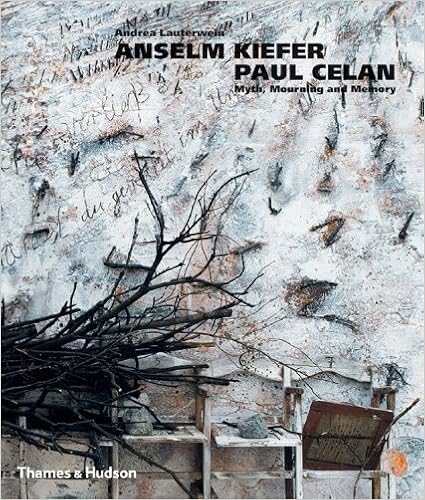
Anselm Kiefer/Paul Celan: Myth, Mourning and Memory Hardcover – August 28, 2007 by Andrea Lauterwein (Author) Through Celan's linguistic innovations and Kiefer's intense exploration of past and present, artistic creation becomes both an expression of horror and an act of commemoration.
The art of Anselm Kiefer is rich with references to writers, philosophers, and poets, and his relationship with Paul Celan has been the most complex and intense of these dialogues with the past. Celan's poetry, inextricably linked with the memory of the Holocaust, has haunted Kiefer's work for more than twenty-five years and has influenced him on every level, from the naming of works and exhibitions to the incorporation of symbolic materials from Celan's imagery—sand, straw, hair, and ashes—into his paintings.
Like other German artists of his generation, Kiefer began by questioning his own artistic heritage, focusing on the iconographic and mythological elements of German culture that had been taken over by Nazi propaganda, and subsequently repressed and buried deep in the collective unconscious. It was his encounter with Celan's work in the early 1980s that first enabled him to escape from the vicious circle of fascination and disgust at the cultural ties that bound him to the Third Reich, leading him to confront the subject of the Holocaust and Jewish memory as a whole and to embrace this body of traditions within his art.
Magnificently illustrated throughout with reproductions of Kiefer's best-known works, this book explores the intricate web of associations between the poet and the painter, a network that is extended to embrace other artistic and literary figures such as Ingeborg Bachmann and Joseph Beuys. 157 illustrations, 140 in color.
Wikipedia
Anselm Kiefer (born March 8, 1945) is a German painter and sculptor. He studied with Joseph Beuys and Peter Dreher during the 1970s. His works incorporate materials such as straw, ash, clay, lead, and shellac. The poems of Paul Celan have played a role in developing Kiefer's themes of German history and the horror of the Holocaust, as have the spiritual concepts of Kabbalah. In his entire body of work, Kiefer argues with the past and addresses taboo and controversial issues from recent history. Themes from Nazi rule are particularly reflected in his work; for instance, the painting "Margarethe" (oil and straw on canvas) was inspired by Paul Celan's well-known poem "Todesfuge" ("Death Fugue"). His works are characterized by an unflinching willingness to confront his culture's dark past, and unrealized potential, in works that are often done on a large, confrontational scale well suited to the subjects. It is also characteristic of his work to find signatures and/or names of people of historical importance, legendary figures or places particularly pregnant with history. All of these are encoded sigils through which Kiefer seeks to process the past; this has resulted in his work being linked with a style called New Symbolism. Kiefer has lived and worked in France since 1991. Since 2008, he has lived and worked primarily in Paris[1] and in Alcácer do Sal, Portugal.[2]
Art critic for The New York Times, Robert Hughes Interview


 See this image


沒有留言:
張貼留言