|
2020年4月19日 星期日
Kim Yong-hee, 60, 向三星Samsung抗議


2020年4月18日 星期六
Paul O’Neill, Former Treasury Chief and Alcoa CEO, Dies at 84
"Paul O’Neill, Former Treasury Chief and Alcoa CEO, Dies at 84" 他要求美國財政部三天內結帳;IMF不要援助三國;批評某董事會只是吹他們管治多好,其實不然.....
---
1996年的那位理科學生,後來成為王醫生。去年我們重識。
臉書抽樣,可知他的忙碌.....
今天說某病人往生(93歲)前交代兒子要給王醫師禮物。我以前在Dr. W. Edwards Deming 的記述中,知道一封感謝信就很感動,晚年的 Dr. Deming 會給醫院捐錢。
Politics
Paul O’Neill, Former Treasury Chief and Alcoa CEO, Dies at 84
By Simon Kennedy and Brendan Murray
2020年4月18日 下午9:57 [GMT+8] Updated on 2020年4月19日 上午1:31 [GMT+8]
Outspokenness got him tossed out of George W. Bush’s Cabinet
As Alcoa’s CEO, he turned around an old-economy company
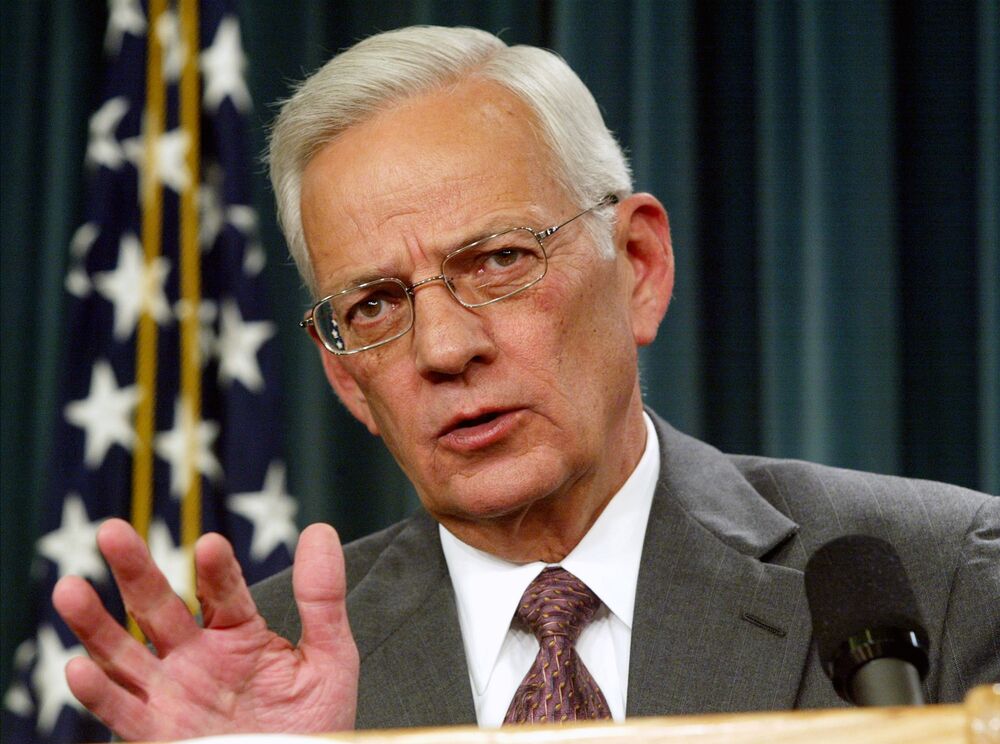 Paul O’Neill speaks during a Pre-G7 Ministerial Meeting in 2002. Photographer: Alex Wong/Getty Images
SHARE THIS ARTICLE
Share
Tweet
Post
Email
In this article
AA
ALCOA CORP
7.59
USD
+0.63+9.05%
IP
INTL PAPER CO
31.85
USD
+1.38+4.53%
TWTR
TWITTER INC
26.70
USD
+0.15+0.56%
BX
BLACKSTONE GRO-A
50.01
USD
+2.05+4.27%
Paul O’Neill, whose outspokenness cost him his job as President George W. Bush’s first Treasury secretary after having led Alcoa Inc. through a period of consistent profitability, has died. He was 84.
O’Neill died Saturday at his home in Pittsburgh after battling lung cancer for the last few years, his family said.
O’Neill ran the Treasury Department for almost two years and was the first casualty of Bush’s Cabinet after roiling financial markets and managing to offend three of the job’s main constituencies: Wall Street, Congress and foreign officials.
His dismissal during a sluggish recovery from the 2001 recession followed a career that included turning the largest U.S. aluminum producer from a company profitable mostly when the commodity’s prices were high into a standard-setter that made money in 11 of his 12 full years at the helm.
“Saddened to hear of the passing of the former 72nd Treasury Secretary,” Steven Mnuchin, the current U.S. Treasury chief, said on Twitter. “He served @USTreasury and America with distinction during challenging times.”
In an administration that shunned disunity, O’Neill disagreed with two of its most contentious foreign and domestic policies: the decision to invade Iraq and a second round of tax cuts to revive the economy.
His feuds with the White House were chronicled in “The Price of Loyalty,” a 2004 book that Pulitzer Prize-winning journalist Ron Suskind wrote using interviews and thousands of pages of Treasury documents provided by O’Neill.
A self-styled straight-talker who tried to introduce business practices to politically-driven Washington, O’Neill rarely withheld his frustration with the conventions of politics or international policy making.
Unconventional Positions
Saying he saw little value in words not backed by action, he loathed the U.S. “strong dollar” policy, a mostly rhetorical device aimed at markets and championed by Robert Rubin, the second of Bill Clinton’s three Treasury secretaries. O’Neill sought to limit to a single sheet the multi-page communiques distributed by Group of Seven finance ministers. And he favored factory tours over the ceremony of speeches that typically accompanied the job.
For Bush, who entered office in 2001 planning to overhaul the nation’s Social Security system, the outspoken Treasury secretary with a preference for fiscal restraint became more of a liability in a post-Sept. 11 world of wars and ballooning budget deficits. O’Neill departed in December 2002 after those he challenged took offense, and publications including the New York Times and the Wall Street Journal predicted his sacking.
“Doing the right thing is good politics,” O’Neill said in June 2002. “I don’t know how to sort it out any other way, and it’s what I’m going to do until I get fired or pull the rip cord. If people don’t like what I’m doing, I don’t give a damn.”
‘Steady Hand’
Early on, Bush described O’Neill as a “steady hand” who would soothe investors after nominating him on the advice of Dick Cheney, who became vice president, and then-Federal Reserve Chairman Alan Greenspan. O’Neill pledged that his days as a “free-ranging, self-admitted maverick” were over.
They were all wrong. Within two months O’Neill sent the dollar plunging when he told a German newspaper the U.S. didn’t really follow the strong dollar policy, suggested Bush’s tax cut wouldn’t boost the economy as much as the administration calculated, and told Wall Street traders he could learn their jobs in a few weeks.
O’Neill said his refusal to stick to scripts and his willingness to speak his mind proved he was an independent thinker trying to “give people an education.” Senator Chuck Grassley once said “more of his unreserved honesty is needed inside the Beltway.”
Other defenders said O’Neill’s assessments were often accurate if not always politically savvy. He questioned the virtue of Bush’s steel tariffs and U.S. policy on Cuba even though those views veered from the administration’s ideas. In another true-but-tactless howler, he said in defense of atomic power: “If you set aside Three Mile Island and Chernobyl, the safety record of nuclear is really very good.”
Initially, he was willing to do some political heavy-lifting for Bush, helping push a $1.35 trillion tax cut through Congress in 2001 faster than lawmakers had predicted. When the U.S. economy slid into a recession in O’Neill’s opening three months, he became the first Treasury chief to preside over a contraction since Nicholas Brady in the early 1990s.
Terror Attacks
The terrorist attacks in September 2001, which forced O’Neill to cut short a trip to Tokyo and return to Washington on a military plane, shattered the nation’s confidence and worsened the federal budget, which in 2002 fell into a deficit for the first time since 1997. The unemployment rate, at 4.2% when O’Neill was sworn into office, reached a 7 1/2-year high of 6% the month he was fired.
“Secretary O’Neill lived his life and served his country -- and humanity -- with dignity, brutal honesty, a pragmatic passion to solve problems, a drive for excellence and the highest level of integrity I’ve ever personally witnessed,” Tim Adams, president of the Institute of International Finance, said in a statement.
John Snow, the former chief executive officer of CSX Corp., replaced O’Neill and helped Bush secure congressional approval for the second round of tax reductions he’d sought.
The Suskind book stirred Washington with its description of Bush being “like a blind man in a roomful of deaf people,” with little interest in policy and an accusation that Bush entered office already planning to attack Iraq. O’Neill said he read pages of analysis on Iraq and saw little reason to invade. The intelligence used to justify the invasion later proved flawed.
In his 2010 memoir “Decision Points,” Bush wrote that O’Neill never openly disagreed with the administration’s plan to reduce taxes and that he and the Treasury chief he called Pablo “never clicked.”
“He didn’t gain my confidence, nor credibility with the financial community or Congress,” Bush wrote.
‘Never Clicked’
O’Neill took issue with Bush’s claim that he didn’t openly oppose the tax cuts.
“It is not true,” O’Neill said on Bloomberg Television in December 2010. He said he raised his objections in April, August and November 2002.
“One of the things he says in the book is that the two of us never clicked,” O’Neill said in the interview. “To that I would say, ‘Amen.’ I could never figure out how to have a logical progressive conversation with him about anything.”
Paul Henry O’Neill, born on Dec. 4, 1935, in St. Louis, moved often during his childhood with his father’s military transfers, living in Alaska, Hawaii and elsewhere. He once clashed with Senator Robert Byrd, the long-serving Democrat from West Virginia, about who had the poorest childhood.
“I started my life in a house without water or electricity,” O’Neill told Byrd at a 2002 hearing, in a tense exchange that almost brought the Treasury secretary to tears before a packed room.
O’Neill studied economics at California State University at Fresno, and earned a master’s degree in public administration from Indiana University in Bloomington.
Government Jobs
His government career began as a computer systems analyst at the Veterans Affairs Department in 1961, moving to the Office of Management and Budget from 1967 to 1977. He worked in the administrations of Lyndon B. Johnson and Richard M. Nixon before rising to deputy budget director under Gerald R. Ford.
During Ford’s presidency, O’Neill developed friendships with Greenspan, then chairman of the Council of Economic Advisers, Donald Rumsfeld and Cheney, who both served as chief of staff. O’Neill later said he greatly admired Ford. In 2019, the Gerald R. Ford Foundation awarded him its medal of distinguished public service.
Leaving government after Ford’s election defeat in 1976, O’Neill made his fortune as an executive at International Paper Co., where he was president from 1985 to 1987, and New York-based Alcoa. In his 2001 financial disclosure, he reported assets valued between $67 million and $253 million, making him one of the wealthiest officials in the Bush administration.
At Alcoa, where he was CEO from 1987 to 1999, O’Neill boosted factory efficiency and empowered plant managers, instead of company higher-ups, to make decisions. He also literally knocked down the walls at Alcoa’s offices in Pittsburgh, its headquarters at the time, to improve communication. He abandoned his corner office and placed executives in cubicles, an initiative he carried to the Treasury to the dismay of some civil servants in the department’s 19th-century building.
Rebuilding Alcoa
O’Neill’s term at Alcoa, during which its workforce swelled to more than 140,000 from 48,000, won praise from union officials and became the subject of a Harvard Business School case study. During his tenure, he turned around an old-economy company over a nearly 12-year period in which U.S. manufacturers hemorrhaged more than 200,000 jobs.
In a steel town with a rich history of unions, he sought to improve workplace conditions to render organized labor unnecessary. His campaign to raise worker safety improved Alcoa’s record to 0.2 lost workday incidents, or accidents for every 100 workers that led to days off work, from 1.86, according to one Harvard study.
“I always felt O’Neill had a concern and sensitivity for working people,” George Becker, a former president of the United Steelworkers Union, said in March 2001. O’Neill “knows you have to make things to create wealth.”
Sports Car
After returning to Washington to serve under Bush -- whom he initially tried to rebuff, saying he was the wrong man for the job -- O’Neill sought to improve productivity and motivate employees by again emphasizing safety. Always in public with a neatly trimmed head of white hair, he started work before dawn, commuting in a silver Audi TT sports car from his apartment at the Watergate complex, preferring it to a government-assigned car escorted by Secret Service guards.
O’Neill’s relationship with Wall Street deteriorated at the start, when he derided traders as “not the sort of people you would want to help you think about complex questions.” It didn’t help when he raised doubts about his dedication to a strong currency and traveled to Central Asia in July 2002 even as the S&P 500 Index posted its largest decline since the October 1987 crash.
He strained ties with Congress by initially refusing to divest almost $100 million of Alcoa stock before agreeing to do so. He described the efforts of his own party’s legislators to bolster the economy as “show business” -- yet another you-can’t-handle-the-truth assertion.
Business Savvy
Before an October 2001 Senate hearing, Bush reminded his Treasury secretary, “Paul, don’t go and be argumentative,” O’Neill later recalled.
O’Neill’s business acumen and eagerness to buck convention did produce results. Arguing that the government should behave more like a private company, he pared the length of time it took the Treasury to close its month-end financial books to three days from several weeks.
He persuaded international governments to boost the amount of grants made by the World Bank and crack down on financing of terrorism. He toured Africa in May 2002 with U2 front man Bono, drawing global media attention to the continent’s poverty and scoring O’Neill the honorific of being the first Treasury secretary to appear on the “Oprah Winfrey Show.”
Elsewhere on the global stage, O’Neill stirred controversy by pledging to end large financial bailouts for emerging market countries in crisis and then supporting International Monetary Fund loans for Turkey, Argentina and Brazil. He said Argentina had “no industry to speak of,” and his motorcade was pelted with eggs when he visited there. He twice sent Brazilian bonds reeling by saying additional aid didn’t “seem brilliant” and then suggesting the funds might end up in “Swiss bank accounts.”
After leaving government, O’Neill returned to Pittsburgh, the reborn steel town where he came from to pursue his interest in making the medical industry there more efficient and advising New York-based Blackstone Group LP.
As of mid-2019, it was apparent that time hadn’t much diminished his inclination for frank discourse.
In a dispute with a local hospital board on which he served, O’Neill pulled no punches in comments carried in the local newspaper. “I discovered quickly that the board was a sham. The board meetings were a sham. They were show-and-tell about how wonderful they were; and they weren’t.”
O’Neill and his wife, Nancy, had four children: Patricia, Margaret, Julie and Paul.
(Updates with Mnuchin, other reaction from fifth paragraph.)
2020年4月18日 下午9:57 [GMT+8] Updated on 2020年4月19日 上午1:31 [GMT+8]
Outspokenness got him tossed out of George W. Bush’s Cabinet
As Alcoa’s CEO, he turned around an old-economy company
Paul O’Neill speaks during a Pre-G7 Ministerial Meeting in 2002. Photographer: Alex Wong/Getty ImagesSHARE THIS ARTICLE
Share
Tweet
Post
In this article
AA
ALCOA CORP
7.59
USD
+0.63+9.05%
IP
INTL PAPER CO
31.85
USD
+1.38+4.53%
TWTR
TWITTER INC
26.70
USD
+0.15+0.56%
BX
BLACKSTONE GRO-A
50.01
USD
+2.05+4.27%
Paul O’Neill, whose outspokenness cost him his job as President George W. Bush’s first Treasury secretary after having led Alcoa Inc. through a period of consistent profitability, has died. He was 84.
O’Neill died Saturday at his home in Pittsburgh after battling lung cancer for the last few years, his family said.
O’Neill ran the Treasury Department for almost two years and was the first casualty of Bush’s Cabinet after roiling financial markets and managing to offend three of the job’s main constituencies: Wall Street, Congress and foreign officials.
His dismissal during a sluggish recovery from the 2001 recession followed a career that included turning the largest U.S. aluminum producer from a company profitable mostly when the commodity’s prices were high into a standard-setter that made money in 11 of his 12 full years at the helm.
“Saddened to hear of the passing of the former 72nd Treasury Secretary,” Steven Mnuchin, the current U.S. Treasury chief, said on Twitter. “He served @USTreasury and America with distinction during challenging times.”
In an administration that shunned disunity, O’Neill disagreed with two of its most contentious foreign and domestic policies: the decision to invade Iraq and a second round of tax cuts to revive the economy.
His feuds with the White House were chronicled in “The Price of Loyalty,” a 2004 book that Pulitzer Prize-winning journalist Ron Suskind wrote using interviews and thousands of pages of Treasury documents provided by O’Neill.
A self-styled straight-talker who tried to introduce business practices to politically-driven Washington, O’Neill rarely withheld his frustration with the conventions of politics or international policy making.
Unconventional Positions
Saying he saw little value in words not backed by action, he loathed the U.S. “strong dollar” policy, a mostly rhetorical device aimed at markets and championed by Robert Rubin, the second of Bill Clinton’s three Treasury secretaries. O’Neill sought to limit to a single sheet the multi-page communiques distributed by Group of Seven finance ministers. And he favored factory tours over the ceremony of speeches that typically accompanied the job.
For Bush, who entered office in 2001 planning to overhaul the nation’s Social Security system, the outspoken Treasury secretary with a preference for fiscal restraint became more of a liability in a post-Sept. 11 world of wars and ballooning budget deficits. O’Neill departed in December 2002 after those he challenged took offense, and publications including the New York Times and the Wall Street Journal predicted his sacking.
“Doing the right thing is good politics,” O’Neill said in June 2002. “I don’t know how to sort it out any other way, and it’s what I’m going to do until I get fired or pull the rip cord. If people don’t like what I’m doing, I don’t give a damn.”
‘Steady Hand’
Early on, Bush described O’Neill as a “steady hand” who would soothe investors after nominating him on the advice of Dick Cheney, who became vice president, and then-Federal Reserve Chairman Alan Greenspan. O’Neill pledged that his days as a “free-ranging, self-admitted maverick” were over.
They were all wrong. Within two months O’Neill sent the dollar plunging when he told a German newspaper the U.S. didn’t really follow the strong dollar policy, suggested Bush’s tax cut wouldn’t boost the economy as much as the administration calculated, and told Wall Street traders he could learn their jobs in a few weeks.
O’Neill said his refusal to stick to scripts and his willingness to speak his mind proved he was an independent thinker trying to “give people an education.” Senator Chuck Grassley once said “more of his unreserved honesty is needed inside the Beltway.”
Other defenders said O’Neill’s assessments were often accurate if not always politically savvy. He questioned the virtue of Bush’s steel tariffs and U.S. policy on Cuba even though those views veered from the administration’s ideas. In another true-but-tactless howler, he said in defense of atomic power: “If you set aside Three Mile Island and Chernobyl, the safety record of nuclear is really very good.”
Initially, he was willing to do some political heavy-lifting for Bush, helping push a $1.35 trillion tax cut through Congress in 2001 faster than lawmakers had predicted. When the U.S. economy slid into a recession in O’Neill’s opening three months, he became the first Treasury chief to preside over a contraction since Nicholas Brady in the early 1990s.
Terror Attacks
The terrorist attacks in September 2001, which forced O’Neill to cut short a trip to Tokyo and return to Washington on a military plane, shattered the nation’s confidence and worsened the federal budget, which in 2002 fell into a deficit for the first time since 1997. The unemployment rate, at 4.2% when O’Neill was sworn into office, reached a 7 1/2-year high of 6% the month he was fired.
“Secretary O’Neill lived his life and served his country -- and humanity -- with dignity, brutal honesty, a pragmatic passion to solve problems, a drive for excellence and the highest level of integrity I’ve ever personally witnessed,” Tim Adams, president of the Institute of International Finance, said in a statement.
John Snow, the former chief executive officer of CSX Corp., replaced O’Neill and helped Bush secure congressional approval for the second round of tax reductions he’d sought.
The Suskind book stirred Washington with its description of Bush being “like a blind man in a roomful of deaf people,” with little interest in policy and an accusation that Bush entered office already planning to attack Iraq. O’Neill said he read pages of analysis on Iraq and saw little reason to invade. The intelligence used to justify the invasion later proved flawed.
In his 2010 memoir “Decision Points,” Bush wrote that O’Neill never openly disagreed with the administration’s plan to reduce taxes and that he and the Treasury chief he called Pablo “never clicked.”
“He didn’t gain my confidence, nor credibility with the financial community or Congress,” Bush wrote.
‘Never Clicked’
O’Neill took issue with Bush’s claim that he didn’t openly oppose the tax cuts.
“It is not true,” O’Neill said on Bloomberg Television in December 2010. He said he raised his objections in April, August and November 2002.
“One of the things he says in the book is that the two of us never clicked,” O’Neill said in the interview. “To that I would say, ‘Amen.’ I could never figure out how to have a logical progressive conversation with him about anything.”
Paul Henry O’Neill, born on Dec. 4, 1935, in St. Louis, moved often during his childhood with his father’s military transfers, living in Alaska, Hawaii and elsewhere. He once clashed with Senator Robert Byrd, the long-serving Democrat from West Virginia, about who had the poorest childhood.
“I started my life in a house without water or electricity,” O’Neill told Byrd at a 2002 hearing, in a tense exchange that almost brought the Treasury secretary to tears before a packed room.
O’Neill studied economics at California State University at Fresno, and earned a master’s degree in public administration from Indiana University in Bloomington.
Government Jobs
His government career began as a computer systems analyst at the Veterans Affairs Department in 1961, moving to the Office of Management and Budget from 1967 to 1977. He worked in the administrations of Lyndon B. Johnson and Richard M. Nixon before rising to deputy budget director under Gerald R. Ford.
During Ford’s presidency, O’Neill developed friendships with Greenspan, then chairman of the Council of Economic Advisers, Donald Rumsfeld and Cheney, who both served as chief of staff. O’Neill later said he greatly admired Ford. In 2019, the Gerald R. Ford Foundation awarded him its medal of distinguished public service.
Leaving government after Ford’s election defeat in 1976, O’Neill made his fortune as an executive at International Paper Co., where he was president from 1985 to 1987, and New York-based Alcoa. In his 2001 financial disclosure, he reported assets valued between $67 million and $253 million, making him one of the wealthiest officials in the Bush administration.
At Alcoa, where he was CEO from 1987 to 1999, O’Neill boosted factory efficiency and empowered plant managers, instead of company higher-ups, to make decisions. He also literally knocked down the walls at Alcoa’s offices in Pittsburgh, its headquarters at the time, to improve communication. He abandoned his corner office and placed executives in cubicles, an initiative he carried to the Treasury to the dismay of some civil servants in the department’s 19th-century building.
Rebuilding Alcoa
O’Neill’s term at Alcoa, during which its workforce swelled to more than 140,000 from 48,000, won praise from union officials and became the subject of a Harvard Business School case study. During his tenure, he turned around an old-economy company over a nearly 12-year period in which U.S. manufacturers hemorrhaged more than 200,000 jobs.
In a steel town with a rich history of unions, he sought to improve workplace conditions to render organized labor unnecessary. His campaign to raise worker safety improved Alcoa’s record to 0.2 lost workday incidents, or accidents for every 100 workers that led to days off work, from 1.86, according to one Harvard study.
“I always felt O’Neill had a concern and sensitivity for working people,” George Becker, a former president of the United Steelworkers Union, said in March 2001. O’Neill “knows you have to make things to create wealth.”
Sports Car
After returning to Washington to serve under Bush -- whom he initially tried to rebuff, saying he was the wrong man for the job -- O’Neill sought to improve productivity and motivate employees by again emphasizing safety. Always in public with a neatly trimmed head of white hair, he started work before dawn, commuting in a silver Audi TT sports car from his apartment at the Watergate complex, preferring it to a government-assigned car escorted by Secret Service guards.
O’Neill’s relationship with Wall Street deteriorated at the start, when he derided traders as “not the sort of people you would want to help you think about complex questions.” It didn’t help when he raised doubts about his dedication to a strong currency and traveled to Central Asia in July 2002 even as the S&P 500 Index posted its largest decline since the October 1987 crash.
He strained ties with Congress by initially refusing to divest almost $100 million of Alcoa stock before agreeing to do so. He described the efforts of his own party’s legislators to bolster the economy as “show business” -- yet another you-can’t-handle-the-truth assertion.
Business Savvy
Before an October 2001 Senate hearing, Bush reminded his Treasury secretary, “Paul, don’t go and be argumentative,” O’Neill later recalled.
O’Neill’s business acumen and eagerness to buck convention did produce results. Arguing that the government should behave more like a private company, he pared the length of time it took the Treasury to close its month-end financial books to three days from several weeks.
He persuaded international governments to boost the amount of grants made by the World Bank and crack down on financing of terrorism. He toured Africa in May 2002 with U2 front man Bono, drawing global media attention to the continent’s poverty and scoring O’Neill the honorific of being the first Treasury secretary to appear on the “Oprah Winfrey Show.”
Elsewhere on the global stage, O’Neill stirred controversy by pledging to end large financial bailouts for emerging market countries in crisis and then supporting International Monetary Fund loans for Turkey, Argentina and Brazil. He said Argentina had “no industry to speak of,” and his motorcade was pelted with eggs when he visited there. He twice sent Brazilian bonds reeling by saying additional aid didn’t “seem brilliant” and then suggesting the funds might end up in “Swiss bank accounts.”
After leaving government, O’Neill returned to Pittsburgh, the reborn steel town where he came from to pursue his interest in making the medical industry there more efficient and advising New York-based Blackstone Group LP.
As of mid-2019, it was apparent that time hadn’t much diminished his inclination for frank discourse.
In a dispute with a local hospital board on which he served, O’Neill pulled no punches in comments carried in the local newspaper. “I discovered quickly that the board was a sham. The board meetings were a sham. They were show-and-tell about how wonderful they were; and they weren’t.”
O’Neill and his wife, Nancy, had four children: Patricia, Margaret, Julie and Paul.
(Updates with Mnuchin, other reaction from fifth paragraph.)
訂閱:
文章 (Atom)