'Barry Lyndon' (1975), directed by Stanley Kubrick
During the production of Barry Lyndon, director Stanley Kubrick was renowned for his meticulous attention to detail, particularly in achieving authentic lighting for the film’s 18th-century setting. To authentically capture scenes illuminated solely by candlelight, Kubrick employed specially adapted Zeiss lenses with an exceptionally wide aperture of f/0.7, originally developed for NASA. 
This innovative approach, while visually stunning, presented significant challenges on set. The abundance of candles consumed large amounts of oxygen, leading to concerns about air quality for the cast and crew. Additionally, the heat and smoke generated by the candles necessitated creative solutions, such as the use of reflectors to amplify illumination without exacerbating these issues. 
Despite these challenges, Kubrick’s commitment to authenticity resulted in a film celebrated for its painterly aesthetic and groundbreaking cinematography, vividly bringing the 18th-century milieu to life.
As opioid epidemic grows, the company that makes a medication to block the effects of an overdose says it will give a free carton of the antidote to any U.S. high school.
It wasn’t so much the axe-wielding maniac, the twins or the corridor of blood that left Peter Kimpton sleepless, but that he began to doubt his own eyes on first view of Kubrick’s classic
The dream-like opening of The Shining
All at once I am flying across a Colorado lake and mountains, with a yellow VW Beetle down below, heading towards the vast, bleak, Overlook hotel. Jack Torrance (Jack Nicholson) is calmly agreeing to be caretaker with wife Wendy and son Danny over the winter period, but everybody else is heading in the other direction. He’s grinning, and says he hopes to get some writing done. In my experience that’s already a bad sign. And alongside the splendour of the setting, there’s a blandness about the packing away, the end-of-season closing down. It’s a normality, with aura of something not right. This, and the early part of the score, really gets under your skin. There’s a powerful sense of foreboding. The combination is dream-like, inexorable, and as Stanley Kubrick undoubtedly planned, makes you feel vulnerable.
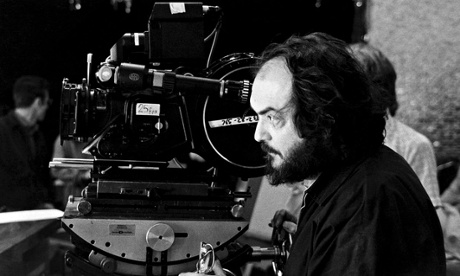
Would you trust this man? He’s scary enough in this shot. Stanley Kubrick on the set of The Shining, 1980.Photograph: Everett Collection/REX
There are many terrifying things in Kubrick’s horror masterpiece. There’s the rattling, stabbing, jagged violins at key moments using music from Krzysztof Penderecki’s Polymorphia. Then there’s little Danny’s imaginary friend, Tony, who lives in his finger, or mouth or wherever, and speaks in Exorcist-type robotic tones, climaxing in the REDRUM /MURDER mantra written on the bedroom door. There’s the horrible death of amiable head chef Mr Halloran, Danny’s psychic shine friend, chopped down when all he does is to drive through the snow to see if they’re alright. No! He killed Scatman Crothers, the voice of Hong Kong Fooey and occasionally on Scooby Doo. Then there’s the woman in room 237, who commits the mortal sin of turning old and rotting very quickly in the middle of a naked snog. Urrgh. Shiver! And then, after the brilliantly innovative floor-level Steadicam footage of Danny tricycling through the corridors, there’s the terrible twins. OK, Let’s play it.
Come play with us, Danny. For ever and ever.
Yet the scariest thing about The Shining is how it always plays with your perceptions. The most shocking revelation comes in the typewriter scene, where Wendy, played by Shelley Duvall, who does frightened like nobody else and is film’s answer to Edvard Munch’s The Scream, discovers that her husband has typed, over and over, nothing but reams of the same phrase: “All work and no play makes Jack a dull boy.” As she glances through, the typing also contains fleeting glimpses of the phrase mutate into “dolt boy” to “adult boy”.
But even before this catastrophic moment, Kubrick seems to have been playing subliminal games. I did not notice this until years later, but in a precursor scene in the same Colorado lounge, when Jack tells Wendy not to disturb him when he is writing, the typewriter changes from a small white model to a large grey one, and a chair in in the background disappears, reappears and disappears. The film is full of other object and hotel layout anomalies which subconsciously cause us disquiet. They simply cannot be continuity errors from a director so well known to be painstakingly meticulous. So, after Wendy’s discovery, a central scene unfurls in which Jack explains his “obligations”.
Things go a bit batty for Jack Nicholson and Shelley Duvall in The Shining.
Although there’s nothing friendly about a river of blood in a corridor, mental breakdown can be just as frightening as physical horror. Much has been said about the hidden messages in the film, that it plausibly refers to the killing of native Americans, or more obscurely the Holocaust, or perhaps even less likely, clues that Kubrick helped create false footage of the Apollo 11 moon landing. Much of this is discussed in the Rodney Ascher’s interesting 2012 documentary, Room 237.
But the dialogue in the bat-swinging scene for me hits the heart of the horror, the centre of this maze of corridors, hedges and carpet patterns, and Jack’s so-called minotaur within it. Jack seems to turn on his family not because of visions or demons, but because he cannot find a proper job, a role, an identity, and balance this with ordinary family life, and adulthood. He has driven himself mad from an obsession with his contractual obligation at the Overlook hotel. The feeling is shaped by his offbeat, surreal encounters in the dining room with the ghosts of barman Lloyd and caretaker Grady. He tells his wife “I gave my word’ - and that she doesn’t understand his “responsibilities”. Here is the banality of evil from everyday life, out of drudgery, and that is key to why it’s all so frightening.
But that doesn’t deny me being absolutely terrified by such scenes as when Wendy glimpses a man dressed as a rabbit appearing to give another man a blowjob in the 1920s. The scariness, the first time, came because it happens quickly, the camera zooms as they look back at you, and because you’re not really sure what you’re seeing. I found myself doubting my own perceptions.
Was that a rabbit?
While it isn’t the actual plot climax to the film, the absolutely most chilling moment is also the funniest. I’m referring, of course, to the door-chopping scene, with Nicholson’s twisting nursery rhymes and where he improvised a phrase from the Johnny Carson show. Kubrick, living in the UK at the time, didn’t get the reference at first, and nearly cut it. It still makes me jump, even though I know what’s coming up.
Here he is, then.
The film ended. And as Jack sat frozen in the maze, I sat frozen in a cold sweat to the sofa. I didn’t sleep at all that night. My parents came home and I locked my bedroom door, but that wouldn’t have stopped Jack. And when I eventually did sleep the next night, it was far from restful then, or for several weeks. Why? Not so much due to scenes of bloody horror, but more because I wasn’t really sure what I was seeing, and it several years for me to understand why. Is this a shared experience, or was I going slightly mad?


沒有留言:
張貼留言