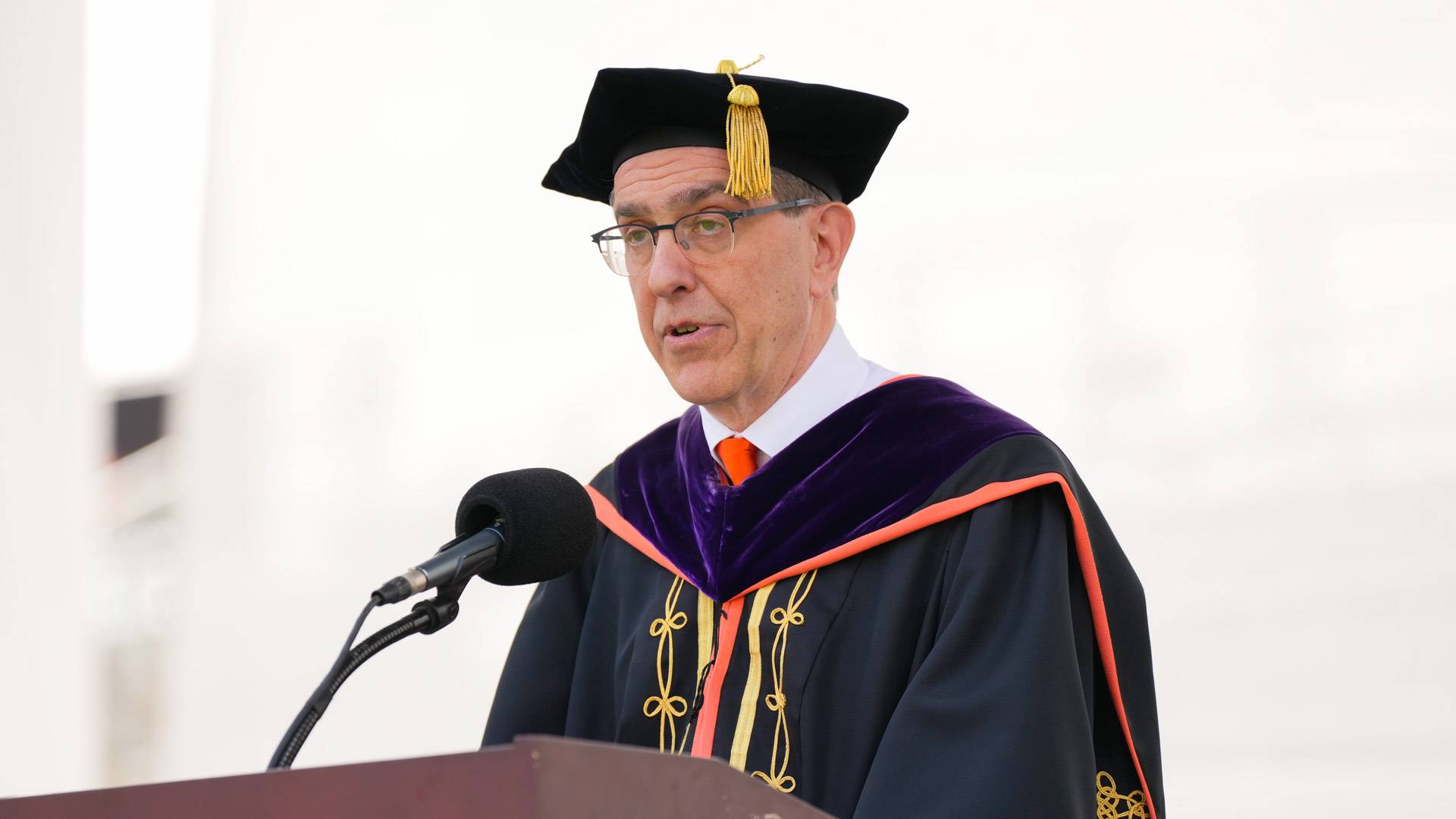
President Eisgruber’s Commencement address: ‘Learning, Citizenship, and the Courage to Be Unpopular’
hc 選文, Google 翻譯。
羅伯特·弗朗西斯·戈恩(1919 年 - 2008 年)是一位美國學者,曾任普林斯頓大學校長(1957-1972 年)和美國駐印度大使(1977-1980 年)。
Robert Francis Goheen (1919 – 2008) was an American academic, president of Princeton University 1957–1972 and United States Ambassador to India 1977-1980 .
Robert F. Goheen | |
|---|---|
 Goheen at Princeton in 1936 | |
| 16th President of Princeton University | |
| In office 1957–1972 | |
| Preceded by | Harold W. Dodds |
| Succeeded by | William G. Bowen |
| United States Ambassador to India | |
| In office May 26, 1977 – December 10, 1980 | |
| President | Jimmy Carter |
| Preceded by | Bill Saxbe |
| Succeeded by | Harry G. Barnes Jr. |
戈亨於 1950 年至 1957 年在普林斯頓大學擔任古典學助理教授,之後被任命為該校第 16 任校長。他於 1957 年至 1972 年擔任該校校長。 [8] 37 歲時,他是自 18 世紀以來擔任該職位最年輕的人。面對1960年代的社會和政治挑戰,戈亨鼓勵學生參與決策過程,積極招收少數族裔學生,並於1969年監督了女性的入學。在他去世後,《紐約時報》報道:「戈亨博士最終建造或購置了38棟建築,使大學的室內面積增加了80%。他將預算增加了三倍,校友捐贈翻了一番,教職員工數增加了40%。…在戈亨博士的領導下,普林斯頓大學發生了根本性的變化,從一一個精英雲集的學府轉變為一所多元化且複雜的綜合性研究型大學。
Goheen taught classics at Princeton as an assistant professor from 1950 until 1957, when he was appointed the university's 16th president. He served as president of the university from 1957 to 1972.[8] At 37, he was the youngest man to assume that position since the 18th century. Faced with the social and political challenges of the 1960s, Goheen encouraged student involvement in decision-making processes and initiated active recruitment of minorities, as well as overseeing the admission of women in 1969. The New York Times reported after his death: "Dr. Goheen would eventually build or acquire 38 buildings, increasing the university’s indoor square footage by 80 percent. He quadrupled the budget, doubled alumni giving and increased the number of faculty members by 40 percent. ... The university changed fundamentally under Dr. Goheen’s leadership, going from an establishment cradle to a diversified and complex research university. He attacked the exclusivity of the eating clubs, even opening one to be run by the university. He hired Princeton’s first black administrator and first black full professor and aggressively recruited promising minority students."[1]
-----
當西奧多·赫斯伯格神父在擔任聖母大學校長初期,曾問戈亨博士,他的學校(規模與普林斯頓大學大致相同)如何才能獲得普林斯頓大學那樣的學術聲譽時,戈亨博士回答說:“首先,解僱橄欖球教練。”
When the Rev. Theodore Hesburgh, early in his tenure as president of Notre Dame, asked Dr. Goheen once how his school, much the same size as Princeton, could go about getting Princeton’s reputation for scholarship, Dr. Goheen answered, "First, fire the football coach."
Robert F. Goheen, Innovative Princeton President, Is Dead at 88
https://www.nytimes.com/2008/04/01/nyregion/01goheen.html
-----
2026年普林斯頓大學校長畢業典禮講詞
Goheen collected his thoughts about Princeton and higher education in a book titled The Human Nature of a University.[3]
In the closing paragraphs to that book, Goheen reflected “on th[e] word ‘courage’” and its connection to the mission of the American university. He observed that, and these are his words:
“Hostile forces anchoring on selfish interests, or the status quo, have in every century opposed those institutions dedicated to the advancement of learning and the betterment of human life, and we would be rash indeed to underestimate these forces.”[4]
He ended his book with these words:
“Courage, with temperance, is always needed to hold the university to its role and mission: courage on the part of men and women of good will who cherish the spirit of liberal learning and seek a better day for [humanity]. So girded, the university as a human institution can be confident not only of its past but of its present and future, ready to stand up for its aims and basic commitments, bold to make its voice heard in the land.”[5]
We often think of “courage” as a heroic virtue and associate it with risks to life or limb. On this view, its antonyms are timidity, weakness, or fear.
Goheen, however, contrasted courage with insecurity and vanity, or, more precisely, with the desire to be popular.
Here is what he says about why courage is essential to the university and its members:
“Perhaps the highest and most difficult function of the university, its most irreplaceable form of service in a free society, [is] to be willing to stand up as a judge of society’s tastes and actions. The critic and the judge are not always popular, but the greatest teachers in all ages have preferred hard truth to comfortable fiction and self-respect to popular esteem.”[6]
戈亨將他對普林斯頓大學和高等教育的思考匯集成書,書名為《大學的人性》[3]。
在書的結尾段落中,戈亨反思了「勇氣」一詞及其與美國大學使命的聯繫。他觀察到這一點,以下是他的原話:
「每個世紀,那些以自私利益或維護現狀為根基的敵對勢力,都反對那些致力於推進學術發展和改善人類生活的機構,我們若低估這些勢力,實屬魯莽。」[4]
他在書的結尾寫道:
「要使大學履行其職責和使命,始終需要勇氣,同時也要保持節制:這種勇氣來自那些珍視博雅教育精神、追求人類更美好未來的善良男女。如此,作為人類機構的大學,不僅能夠對其過去充滿信心,更能對其現在和未來充滿信心,隨時準備捍衛其目標和基本承諾,勇敢地在社會上發出自己的聲音。」[5]
我們通常認為「勇氣」是一種英雄美德,並將其與生命或肢體風險聯繫起來。在這種觀點下,它的反義詞是怯懦、軟弱或恐懼。
然而,戈欣將勇氣與不安全感和虛榮心,或者更確切地說,與渴望受歡迎進行了對比。
以下是他關於勇氣對大學及其成員為何至關重要的論述:
「或許大學最高尚也最艱難的職能,它在自由社會中最不可替代的服務形式,就是勇於挺身而出,評判社會的品味和行為。批評者和評判者並非總是受歡迎的,但歷代最偉大的教師都更傾向於艱難的真理而非舒適的虛構,更傾向於自尊而非大眾的讚譽。」[6]
****
諾貝爾文學獎得主、小說家托妮·莫里森,曾任普林斯頓大學羅伯特·F·戈恩人文講席教授,她 在1996年普林斯頓大學250週年校慶畢業典禮上發表的題為《理念之地;理念之地 sic 原文 “The Place of the Idea; The Idea of the Place,” 應改為 理念之地;地方之理念 》的精彩演講中,也探討了類似的主題。
莫里森指出,普林斯頓大學是由一群宗教異議人士創立的,他們「將良知…置於正統之上」。她認為,這種立場「在殖民時期的教育家眼中如此不受歡迎,以至於顯得魯莽」。 [7]
在演講接近尾聲時,莫里森像戈恩一樣,呼籲人們要有勇氣。她希望普林斯頓大學起源於不受歡迎的異議,能夠激勵普林斯頓人「堅定地秉持…正直、榮譽、公平競爭和勇氣等美德」。 [8]
The Nobel Prize-winning novelist Toni Morrison, who taught at Princeton as the Robert F. Goheen Professor in the Humanities, struck similar themes in her brilliant address titled “The Place of the Idea; The Idea of the Place,” which she delivered at Princeton’s 250th anniversary convocation in 1996.
Morrison said that Princeton was founded by religious dissenters who prized “conscience … above orthodoxy,” a position she said was “so unpopular among colonial educators [that it] must have seemed reckless.”[7]
Near the end of her speech, Morrison, like Goheen, called for courage. She hoped that Princeton’s origins in unpopular dissent would inspire Princetonians to maintain “a fierce commitment to … virtues such as integrity and honor and fair play and courage.”[8]
- The Place: Represents the physical geography, historic monuments, and built environments.
- The Idea: Represents the founding principles of liberty, justice, and the philosophical American experiment.
- The National Park Service: Offering events across historical battlefields and locations to reflect on the meaning of both place and idea. [1]
- Smithsonian Institution: Hosting programs designed to celebrate civic engagement and the cultural exchange of American ideas. [1]
「理念之地,理念之地」 “The Place of the Idea; The Idea of the Place,” 應改為 理念之地;地方之理念 》指的是諾貝爾文學獎得主托妮‧莫里森的一篇著名冥想文章。最初,這個概念旨在探索普林斯頓大學的校園環境與其核心原則之間的關係。如今,它已發展成為一種象徵,代表著在國家建國250週年之際(美國250週年慶典),人們如何探索美國的物質環境和理論神話。
核心概念:場所:代表自然地理、歷史古蹟與建築環境。
理念:代表自由、正義與美國哲學實驗的建國原則。
綜合:場所精神(精神場所)與其相關價值觀之間的互動。探索250週年慶典:隨著美國在2026年迎來建國250週年,許多歷史、公民和學術機構都在直接關注這一
交匯點:國家公園管理局:在歷史戰場和遺址舉辦活動,反思場所和理念的意義。史密森學會:舉辦旨在慶祝公民參與和美國思想文化交流的計畫。美國250週年慶典:領導全國性倡議,請各界人士反思過去250年來定義美國的地點和大膽理念。探索物理環境與文化之間的關係。
****
在最高法院的一份著名意見書中,路易斯‧布蘭代斯大法官捍衛了美國人民的言論自由權,他論證:
「對於勇敢自立的人民而言,他們對透過民選政府程序運用自由無畏的理性力量充滿信心,除非所擔憂的危害迫在眉睫,以至於在充分討論之前就會發生,否則任何來自言論的危險都不能被視為顯而易見且迫在眉睫。」[9]
多年來,當我向學生講授這段話時,我一直認為其中提及的勇氣不過是一種修辭手法。我認為這是一種愛國的讚美,雖然討好讀者,但與布蘭代斯想要表達的觀點基本上無關。
只有當我們的社會變得愈發動盪不安時,我才領悟到布蘭代斯所言的真諦,以及羅伯特·戈恩在20世紀60年代的動盪中所認識到的:那就是,若要進行必要的“充分討論”,以駁斥危險的傾向和腐蝕性的思想,公民勇氣和個人勇氣至關重要。
在政治場合、委員會會議上,甚至在朋友間的討論中,與主流觀點相左往往會讓人感到不適。人們難免會傾向於保持沉默,以免傷害他人的感情、失去他們的好感,或冒著遭到報復的風險。
如果我們想要實踐公民和學術的理想,有時就必須挺身而出。即使真理探求和公民責任的準則會將我們引向艱難險阻,我們也必須忠於這些準則。
正如路易斯·布蘭代斯、羅伯特·戈恩和托妮·莫里森所強調的那樣,自治、自由和學習並非總是令人感到舒適的。他們需要獨立,而獨立從定義上來說就意味著有力量獨自站立,以尊重和盡可能禮貌的方式,但仍然毫不掩飾地不受歡迎。
In a famous Supreme Court opinion, Justice Louis Brandeis defended the American people’s right to free speech by arguing that:
“To courageous, self-reliant [people], with confidence in the power of free and fearless reasoning applied through the processes of popular government, no danger flowing from speech can be deemed clear and present unless the incidence of the evil apprehended is so imminent that it may befall before there is opportunity for full discussion.”[9]
For many years when I taught this passage to my students, I treated its reference to courage as a mere rhetorical flourish. I regarded it as patriotic praise that flattered readers but was largely irrelevant to the point that Brandeis was making.
Only as our society became more turbulent did I perceive what Brandeis meant, and what Robert Goheen recognized amidst the tumult of the 1960s: namely, that civic and personal courage are essential if we are to have the “full discussion” that is required to rebut dangerous tendencies and corrosive ideas.
Dissenting from a popular opinion—in politics, in a committee meeting, or in a discussion among friends—will often feel uncomfortable. There is an inevitable temptation to remain silent so as not to hurt other people’s feelings, forfeit their affection, or risk retribution.
If we are to live up to the ideals of citizenship and scholarship, we must sometimes speak anyway. We must be faithful to the standards of truth-seeking inquiry and civic responsibility even when they lead us down difficult paths.
As Louis Brandeis, Robert Goheen, and Toni Morrison all emphasized, self-government, freedom, and learning cannot always be comfortable. They require independence, and independence by definition entails the strength to stand alone, to be respectfully and when possible politely, but nevertheless unabashedly, unpopular.
https://www.princeton.edu/news/2026/05/26/president-eisgrubers-commencement-address-learning-citizenship-and-courage-be

沒有留言:
張貼留言