László Krasznahorkai 拉斯洛·卡撒茲納霍凱: 精彩訪談:《世界繼續運轉 一百個人的故事》在兩千五百年的時間裡--「大約一百人…」..........我至今不知道如何面對那個擁有諾貝爾獎的 Krasznahorka;i我的匈牙利是語言的匈牙利,不是驃騎兵的匈牙利。。 “我要感謝我最初愛上的31位女孩,尤其是瑪蒂·克林科維奇。” 在諾貝爾獎頒獎晚宴上,拉斯洛·克拉斯納霍爾凱發表了一篇充滿詩意、超現實主義的感恩宣言。......這篇宣言既飽含個人情感,又意義深遠,令人驚喜。。卡勒斯納霍凱・拉斯洛(Krasznahorkai László, 1954~ 匈牙利作家)2025 年諾貝爾文學獎,《撒旦的探戈》(Sátántangó)以共產體制崩潰前的農村為舞台——等待奇蹟的村民、假死歸來的騙徒、濕冷的泥地與絕望的幽默。 《鯨魚馬戲團》
László Krasznahorkai 一百代/一百人
László Krasznahorkai:「每十個匈牙利人就有一個是酒鬼……在 Orbán 統治下,我覺得這個數字低估了」◎Xavi Ayén
匈牙利人 László Krasznahorkai自八〇年代起,便致力於將西方文學翻轉,創造新的事物,拓展讀者的心智,並將他們捲入一股如洪流般裹挾前行的語言與心靈奔湧之中。被 Susan Sontag 定義為「末日大師」——「好吧,後來我也做了其他的事,」他補充道——他能夠用單一一個句子寫出一部超過四百頁的小說——
“One Hundred People All Told,” for instance, plays with the proposition that over a period of two thousand five hundred years—“approximately one hundred ...Read more
"I give my thanks to the first 31 girls with whom I fell fatally in love, but especially to Márti Klinkovics."
In his Nobel Prize banquet speech, László Krasznahorkai delivered a poetic, surreal list of gratitude, thanking everyone from his cobbler uncle and Franz Kafka to the city of Kyoto, Patti Smith, Johann Sebastian Bach and even the last wolf in Extremadura. It was equal parts personal, profound and delightfully unexpected.
Krasznahorkai was awarded the 2025 Nobel Prize in Literature "for his compelling and visionary oeuvre that, in the midst of apocalyptic terror, reaffirms the power of art"
由於成長於共產主義國家,又見證了最後導致蘇聯解體的社會動盪,他寫出小說《抵抗的憂鬱》(The Melancholy of Resistance),評審團特別提起故事中那具安靜展示在小鎮中的巨大鯨魚屍骸。那樣的噩夢場景不只影射政治,也在與人世間某種具有破壞潛能的神祕力量對話。
拉斯洛專注於人們在秩序與失序之間的荒謬掙扎,以及社會暴力帶來的衝擊,因此嘗試用作品的形式來反映現實的本質,並展現出黑暗的詩意美感。他在1999年出版的《戰爭與戰爭》(War and War)因此讀來令人不安,2016年《溫克海姆男爵的歸來》(Baron Wenckheim’s Homecoming)長達數頁無標點的長句更令人聯想到他兒時喜愛的福克納――他們都在潛入人性的幽深之處。
此外他也放眼東方,多次前往中國,寫出《庫倫的囚徒》(The Prisoner of Urga)和《天之下的毀滅與悲哀》(Destruction and Sorrow Beneath the Heavens),在探索異文化之餘對現代性進行針砭與辯證。
Congratulations to László Krasznahorkai, who has won the 2025 Nobel Prize in Literature! WLT’s pages have reviews of English translations of three of his works, most recently Elaine Margolin’s review of Chasing Homer, translated into English by John Batki.
László Krasznahorkai:「我的匈牙利是語言的匈牙利,不是驃騎兵的匈牙利」 ◎Jacinto Antón
頂著諾貝爾文學獎的光環,加上那一縷白髮——連同灰白的鬍鬚與純粹湛藍、令人心疼的雙眸——使他散發出一種使徒或先知般的氣質,匈牙利作家 László Krasznahorkai在前一天於CCCB經歷了一場對他這樣一位精煉而嚴苛的作者而言實屬罕見的人潮洗禮之後,在 Alma 酒店的酒吧接受採訪。《撒旦的探戈》與《抵抗的憂鬱》的作者,全身黑衣,曬得出人意料的古銅色,心情極佳,顯得親切和藹,儘管談及祖國政治局勢時,他的神情不免蒙上陰影。將他的著作《為一座宮殿所做的初步工作》擺上桌——書中主角是一位與 Melville 同名的書商——成為重啟話題的契機,延續著2024年在馬拉喀什 Formentor 文學對話中關於《抵抗的憂鬱》裡那頭鯨魚意義的討論。
A:首先,我試圖說服他們不要讀我的書,我是認真的,誠心誠意。我不提供希望,儘管我也不剝奪它。我的書顯然不是食譜書。你無法用它們烹調出一道好菜。它們就像我曾經做過的一鍋燉飯。做壞了,所有燉飯的食材都有,但整體就是行不通,甚至讓我非常難受。但如果有人儘管如此仍決定讀我的書,我的建議是,不要相信任何關於它們的說法。說它們難以閱讀這件事。確實,我使用了異常長的句子。就像當你把一個秘密藏了很久,突然傾洩而出:我愛你 Lucía,我永遠愛你,以及隨之而來的洪流;你無法用短句說出這些。句號的使用受阻,因為我通常是帶著那種對敘述的熱情在寫作。總之,我現在忽然想到:這一切對任何人來說都有趣嗎?有誰對一本書是如何製作的感興趣?如果 Samuel Beckett 向我們解釋《等待果陀》是如何產生的,我們會感到驚訝。我認為他沒有一個既定的想法,就那樣出來了。說真的,我無法多說什麼。我腦子裡有某個東西,我把它構成並寫下來。如果讀者某天過得不好,就去買這本書。
Q:這樣說來……
A:重要的是讀者認出自己。他自身尊嚴的脆弱。讓他意識到,那份尊嚴是最後可以被剝奪的東西,但它是可以被剝奪的。這是我和我的朋友 Béla Tarr 的不同之處。他相信一個人的尊嚴是無法被剝奪的。
The New York Review of Books Adam Thirlwell on László Krasznahorkai, “one of the great inventors of new forms in contemporary literature” and winner of the 2015 Man Booker International Prize
A preliminary description of Krasznahorkai’s style would include his...
NYBOOKS.COM
Everything you need to know about László Krasznahorkai, winner of the Man Booker International prize
Little known in the English-speaking world, the Hungarian author has been praised by Susan Sontag and WG Sebald and his fans include a film director whose life’s mission is to bring his novels to the screen
Awards such as the Man Booker International prize are doing their job if they bring relatively unknown authors to new readers. If you’ve missed out on László Krasznahorkai’s writing so far, here’s a potted history.
This Hungarian novelist and screenwriter has long been an open secret in some circles, and was described by Susan Sontag as the “contemporary Hungarian master of the apocalypse”. If you are among his admirers, we’d love to hear from you in the comments.
Considered by many to be the most important living Hungarian author, Krasznahorkai was born on 5 January 1954, in Gyula, Hungary, to a lawyer and a social security administrator. He studied law and Hungarian language and literature at university, and, after some years as an editor, became a freelance writer. His first novel, Satantango (1985), pushed him to the centre of Hungarian literary life and is still his best known. He didn’t leave Communist Hungary until 1987, when he travelled to West Berlin for a fellowship – and he has lived in a number of countries since, but returning regularly to Hungary.
In the early 1990s, he spent long periods of time in Mongolia and China, and would later explore Japan – all of which resulted in aesthetic and stylistic experiments and changes in his writing. While writing the novel War & War (1999), he travelled in Europe and lived in Allen Ginsberg’s flat in New York, where the legendary Beat poet advised and helped him. According to his publishers, he now “lives in reclusiveness in the hills of Szentlászló”. His main literary hero is, he says, Kafka: “I follow him always.”
Which are his main translated works, and where should you start?
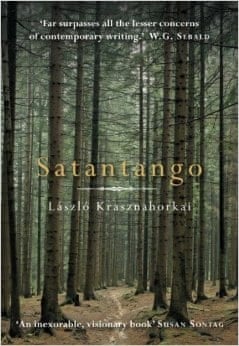
He’s known for his uncompromising style (the 12 chapters of Satantango each consist of a single paragraph) and is often labelled as postmodern. Don’t let that put you off, though. Five of his fictional works have been published in English so far, in translations by Ottilie Mulzet and George Szirtes, who will share the £15,000 translation prize that goes with the Booker. Satantango (1985)
His first and most famous novel. It tells the story of life in a disintegrating village in a dystopian communist Hungary, where a man called Irimias, long thought dead and who may be a prophet, a secret agent or the devil, appears out of nowhere and begins to manipulate the remaining citizens. According to the Guardian review, this is “a monster of a novel: compact, cleverly constructed, often exhilarating, and possessed of a distinctive, compelling vision – but a monster nevertheless. It is brutal, relentless and so amazingly bleak that it’s often quite funny.” It won the 2013 best translated book award in the fiction category.
The Melancholy of Resistance (1989)
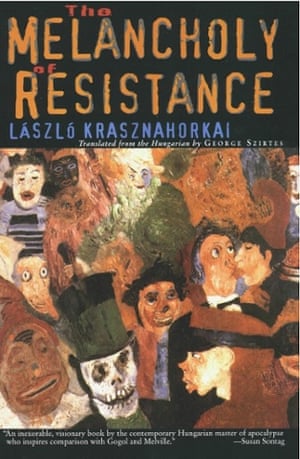
This comedy of apocalypse is set in a town where a mysterious circus, whose only attraction is an enormous whale mounted on a truck, unnerves inhabitants and gives the local would-be tyrant Mrs Eszter what she sees as a perfect opportunity to manipulate the populace.
The form is stream of consciousness, with minimal punctuation. Translator Szirtes described it as “a slow lava flow of narrative, a vast black river of type”.
It won the book of the year award in Germany in 1993.
How about the films?
Both these novels have been made into films by his friend, Béla Tarr, in a collaboration which began with Kárhozat (Damnation) in 1988, and includes aseven-and-a-half-hour black-and-white version of Satantango. This took seven years to make and was released in 1994. Their collaboration continues.
A still from Satantango Photograph: PR/PR
What do the International Booker judges say about him?
Krasznahorkai was chosen from 10 contenders for the £60,000 prize for “an achievement in fiction on the world stage”.
The official citation:
What strikes the reader above all are the extraordinary sentences, sentences of incredible length that go to incredible lengths, their tone switching from solemn to madcap to quizzical to desolate as they go their wayward way; epic sentences that, like a lint roll, pick up all sorts of odd and unexpected things as they accumulate inexorably into paragraphs that are as monumental as they are scabrous and musical.
Chair of judges Marina Warner said:
László Krasznahorkai is a visionary writer of extraordinary intensity and vocal range who captures the texture of present day existence in scenes that are terrifying, strange, appallingly comic, and often shatteringly beautiful. The Melancholy of Resistance, Satantango and Seiobo There Below are magnificent works of deep imagination and complex passions, in which the human comedy verges painfully onto transcendence.
What about his other prominent admirers?
“The contemporary Hungarian master of apocalypse who inspires comparison with Gogol and Melville” – Susan Sontag
“The universality of Krasznahorkai’s vision rivals that of Gogol’s Dead Souls and far surpasses all the lesser concerns of contemporary writing” – WG Sebald
If there are readers who haven’t read my books, I couldn’t recommend anything to read to them; instead, I’d advise them to go out, sit down somewhere, perhaps by the side of a brook, with nothing to do, nothing to think about, just remaining in silence like stones. They will eventually meet someone who has already read my books.
Letters; then from letters, words; then from these words, some short sentences; then more sentences that are longer, and in the main very long sentences, for the duration of 35 years. Beauty in language. Fun in hell.
I’m not interested to believe in something, but to understand the people who believe.” ― in a Q&A
Quotes from the novels
However apparently insignificant the event, whether it be the ring of tobacco ash surrounding the table, the direction from which the wild geese first appeared, or a series of seemingly meaningless human movements, he couldn’t afford to take his eyes off it and must note it all down, since only by doing so could he hope not to vanish one day and fall a silent captive to the infernal arrangement whereby the world decomposes but is at the same time constantly in the process of self-construction.” ― Satantango
Get it into your thick head that jokes are just like life. Things that begin badly, end badly. Everything’s fine in the middle, it’s the end you need to worry about.” ― Satantango
“ [...] What one ought to capture in beauty is that which is treacherous and irresistible” ― War & War
This interview in the White Review (“The similarity [betweeen the time he started writing and the present] is astounding. Everything seems to have changed and yet everything is essentially the same.”)


 。這本書是2015年曼布克獎得獎作,2019年獲得美國國家圖書獎翻譯文學獎。



沒有留言:
張貼留言